
Did you know that Singapore established more than 580 new family office entities in a single year, a surge that reshaped the entire wealth management landscape across Asia? Against this backdrop, VCC 2.0: Single Family Office (SFO) Re-domiciliation has become one of the most searched compliance topics among principals and family office managers looking to consolidate their holdings under Singapore’s regulatory umbrella.
At Lee & Hew, we work closely with family offices navigating this exact transition, and we have seen first-hand how the right structure, paired with disciplined Audit Services Singapore support, can make or break a re-domiciliation timeline.

Key Takeaways: VCC 2.0 Single Family Office Re-domiciliation
- What it is: VCC 2.0 refers to the enhanced Variable Capital Company framework that allows fund managers, including Single Family Offices, to transfer or “re-domicile” existing international fund vehicles into Singapore.
- Who regulates it: The Accounting and Corporate Regulatory Authority (ACRA) administers the VCC Act, while the Monetary Authority of Singapore (MAS) oversees AML/CFT compliance and licensing exemptions.
- Why families are moving: Consolidating scattered assets under one Singapore-domiciled entity reduces administrative duplication and strengthens governance.
- Compliance doesn’t stop at registration: Ongoing statutory audits, tax filings, and company secretarial upkeep are mandatory obligations, not optional extras. Learn more about financial statement audit requirements in Singapore.
- Umbrella structures add efficiency: A single VCC can house multiple sub-funds, sharing service providers and reducing overhead.
- Voluntary audits build trust: Even where not strictly required, voluntary audits reinforce credibility with banks, co-investors, and regulators.
- Foundational reading: For a full primer on the vehicle itself, see our guide on what a Variable Capital Company actually is.
What Is VCC 2.0: Single Family Office (SFO) Re-domiciliation?
VCC 2.0: Single Family Office (SFO) re-domiciliation describes the process by which a family office moves an existing fund vehicle, often domiciled in the Cayman Islands, the British Virgin Islands, or another offshore jurisdiction, into Singapore under the Variable Capital Company framework.
The Variable Capital Company is an investment fund structure that complements the range of investment vehicles already available in Singapore. Fund managers can either establish an entirely new VCC or transfer an existing international fund into Singapore as a VCC, and this second route is precisely what “re-domiciliation” refers to.
In short, VCC 2.0 is not a brand-new law but an evolution of the existing framework, built to make Singapore a more attractive base for wealth structures that were previously scattered across multiple offshore jurisdictions.
Why Family Offices Are Choosing Singapore Over Offshore Jurisdictions
Family offices rarely hold their assets in one place. Research shows the vast majority hold assets across two to four different countries, which highlights exactly why efficient re-domiciliation structures matter so much for the families we advise.
Fragmented holdings mean fragmented reporting, fragmented audits, and fragmented risk. Bringing everything under one Singapore-domiciled VCC simplifies governance considerably.
Competition today demands companies, particularly unicorns, aspiring unicorns, or family-backed investment vehicles, to be creative in how they structure capital to retain trust with co-investors and successor generations alike. A single, well-governed Singapore entity does exactly that.

The Re-domiciliation Process, Step by Step
Being on-time and within budget for a re-domiciliation exercise does not happen by accident. It is the result of structured preparation that begins well before the transfer application is even lodged with ACRA.
- Pre-transfer due diligence: Confirming the foreign fund’s good standing and reviewing its constitutive documents against VCC Act requirements.
- Application to ACRA: Submitting the transfer registration statement, together with solvency declarations from the fund’s directors.
- Deregistration from the foreign jurisdiction: Coordinating timing so there is no gap in the fund’s legal existence.
- Appointment of an authorised fund manager: All VCCs, including SFO structures, must be managed by an entity regulated or exempted by MAS.
- Ongoing compliance setup: Establishing statutory audit, tax, and company secretarial routines from day one.
We act as your outsourced Compliance Officer throughout this sequence, so that you can be assured that you are compliant all the way, from the first ACRA filing through to the first year-end audit sign-off.
Regulatory Framework Governing VCC 2.0: SFO Re-domiciliation
The VCC Act and its related regulations are overseen by ACRA, while MAS supervises compliance with anti-money laundering and countering the financing of terrorism (AML/CFT) obligations. For Single Family Offices specifically, licensing exemptions apply, but only where the structure genuinely serves a single family’s wealth and does not solicit funds from the public.
This distinction matters enormously. Multi-family offices, by contrast, face different thresholds entirely.
Single Family Offices generally sit below this threshold and can rely on specific exemptions, but the paperwork proving eligibility for that exemption is itself a compliance obligation that requires careful, ongoing documentation.
Audit Services Singapore: Why Compliance Doesn’t Stop at Registration
A common misconception is that once a VCC 2.0: Single Family Office (SFO) re-domiciliation is complete, the compliance work is done. It is not.
Statutory financial statement audits ensure ongoing compliance with Singapore accounting standards and regulatory requirements. When auditors sign off on statements, they stake their professional reputation on the results, and that assurance carries real weight with family principals, successor trustees, and any co-investing parties.
Our Audit Services Singapore practice covers group audits, standalone entity audits, and internal audits, all tailored to the specific reporting obligations a re-domiciled VCC faces under FRS/IFRS. Auditors who function as trusted advisors move beyond simple compliance checks; they identify governance gaps before they become problems.
Enhancing your credibility through Lee & Hew’s Audit & Assurance Services means your family office’s re-domiciliation is backed by more than a certificate from ACRA. It is backed by verified, transparent financial reporting.
Umbrella VCC Structures and Sub-Fund Efficiency
One of the more practical advantages of the VCC framework is the umbrella structure. A single umbrella VCC may house multiple sub-funds, each ring-fenced for liability purposes, while sharing service providers such as auditors, fund administrators, and company secretaries.
For a family office managing several distinct investment strategies, whether direct equity, real estate, or fixed income, this structure offers meaningful cost efficiencies. Rather than incorporating three or four separate entities, each with its own board, its own audit, and its own filing calendar, the family consolidates everything under one umbrella with segregated sub-funds beneath it.
Common Pitfalls in VCC 2.0: Single Family Office (SFO) Re-domiciliation
We see the same mistakes recur across re-domiciliation engagements, and most of them are avoidable with proper planning.
- Underestimating the audit timeline: Families often assume the first-year audit can be squeezed into a few weeks. It cannot, particularly where opening balances need to be reconstructed from a foreign jurisdiction’s books.
- Overlooking the fund manager requirement: Every VCC, including SFO structures, must be managed by an authorised or exempted fund manager. Skipping this step delays the entire ACRA application.
- Treating exemptions as automatic: The SFO licensing exemption from MAS is not self-executing; it requires proper documentation and, in many cases, a formal notification.
- Ignoring internal controls: Weak internal controls surface quickly during the first statutory audit and can damage stakeholder trust before the fund has even settled into its new home.
How Voluntary and Internal Audits Strengthen Your Re-domiciliation
Beyond the mandatory statutory audit, many family offices choose to commission a voluntary audit ahead of their VCC 2.0 re-domiciliation to surface any issues early. A structured, value-adding audit can identify process improvements and strengthen governance well before the entity is even transferred into Singapore.
Internal audits play a complementary role. Building a culture of accountability through internal audit reviews reinforces governance and ethical standards, both of which matter enormously to family offices managing generational wealth and reputational risk in equal measure.
Where a family office also receives government or industry grants tied to its investment activities, grant audits add another layer of transparency that regulators and co-investors increasingly expect.

How Lee & Hew Supports Your VCC 2.0: SFO Re-domiciliation
Led by the Founders, entrenched with a Service attitude, grounded with Technical Competence & Integrity, and with a deep sense of Humility, Lee & Hew has continued to grow and has never looked back since our founding as a startup in 2013.
Our integrated suite of services, spanning accounting, audit, tax, and company secretarial support, is designed to ensure that every element of your financial governance is aligned once your VCC 2.0: Single Family Office (SFO) re-domiciliation is underway. With a keen eye on details and international expertise, drawn in part from our membership in the ETL Global network, we provide comprehensive solutions for families moving capital into Singapore.
Our dedicated Financial Services Practice works alongside our general Audit Services Singapore team, giving family offices a single point of contact for both the fund-level audit and the underlying entity’s statutory obligations. Lee & Hew is all about delivering quality solutions on-time, on-target and within budget, for all your Audit, Accounting, Tax, Company Secretarial and Advisory needs, and that promise applies just as much to a re-domiciled VCC as it does to any SME client.
You can read more about the values driving this approach on our About Us page, and browse further guidance on entity setup in our company incorporation and formation resources.
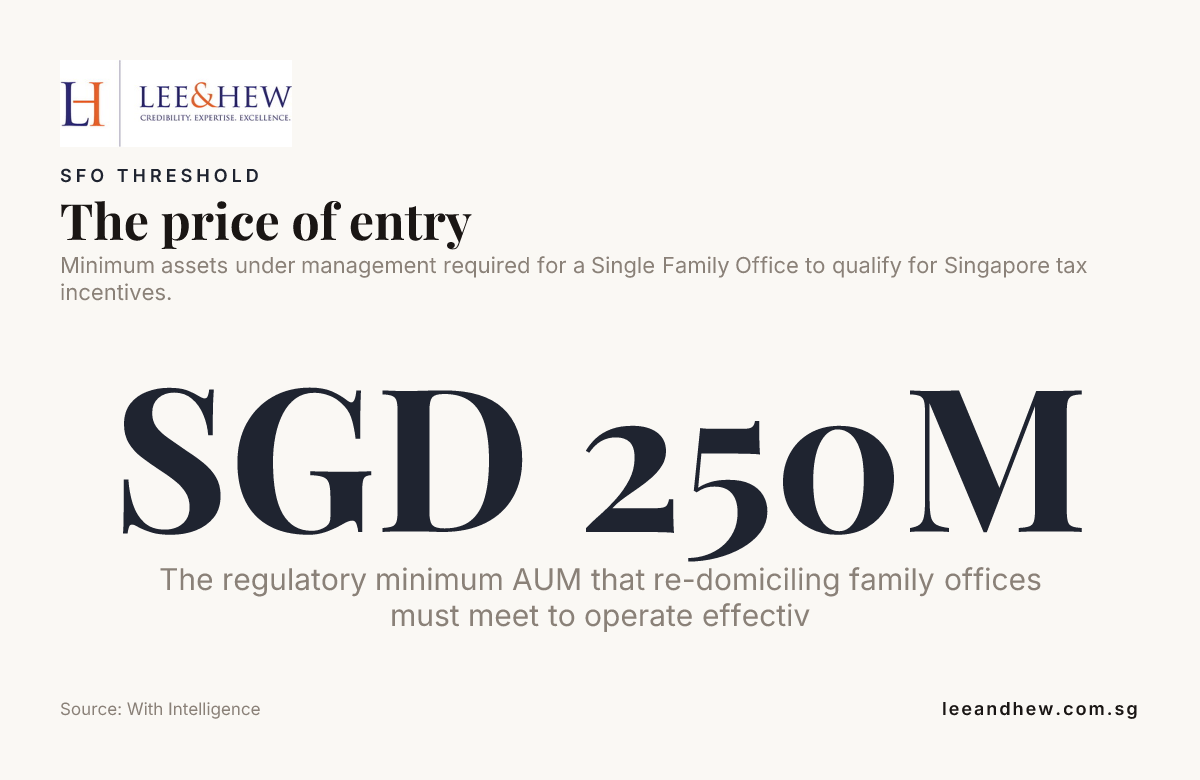 Minimum assets under management required for a Single Family Office to qualify for Singapore tax incentives.
A Genuine Opportunity
VCC 2.0: Single Family Office (SFO) re-domiciliation gives family offices a genuine opportunity to consolidate scattered international holdings under a single, well-governed Singapore structure. The framework itself, overseen by ACRA and MAS, is straightforward on paper, but the practical work of due diligence, audit preparation, and ongoing compliance is where most engagements succeed or stall.
In short, a re-domiciliation is only as strong as the compliance foundation built underneath it, and that foundation depends on disciplined Audit Services Singapore support paired with genuine technical competence. If your family office is weighing a move into a Singapore-domiciled VCC, we would welcome the conversation.
Frequently Asked Questions
What does VCC 2.0 mean for a Single Family Office in Singapore?
VCC 2.0 refers to the enhanced Variable Capital Company framework that allows a Single Family Office to transfer its existing fund vehicle from an offshore jurisdiction into Singapore. The re-domiciliation process is overseen by ACRA, with MAS supervising licensing exemptions and AML/CFT compliance.
Is VCC 2.0 Single Family Office (SFO) re-domiciliation worth pursuing?
For most families holding assets across multiple countries, consolidating under a single Singapore VCC reduces administrative duplication and strengthens governance. The value depends heavily on getting the audit and compliance setup right from the outset, which is where working with an experienced Audit Services Singapore provider makes a real difference.
Does a Single Family Office need a licence to operate under a VCC?
Single Family Offices typically rely on specific exemptions from MAS licensing requirements, provided the structure serves only the wealth of a single family. This exemption is not automatic; it requires proper documentation and notification as part of the re-domiciliation process.
Who regulates VCC 2.0 re-domiciliation in Singapore?
The VCC Act and its related regulations are administered by ACRA, while MAS oversees AML/CFT compliance and any applicable licensing exemptions for Single Family Office structures. All VCCs must also be managed by an authorised fund manager.
How long does a VCC 2.0 SFO re-domiciliation typically take?
The timeline varies depending on the complexity of the foreign fund’s structure and how quickly opening balances and constitutive documents can be verified. Being on-time and within budget for the transfer, much like an audit engagement, depends on structured preparation that begins well before the ACRA application is lodged.
Do re-domiciled VCCs still need annual statutory audits?
Yes. A re-domiciled VCC remains subject to Singapore’s statutory audit requirements under FRS/IFRS, and many families also commission voluntary audits to strengthen governance ahead of the first mandatory review.
Can a single VCC hold multiple family investment strategies?
Yes, through an umbrella VCC structure with separate sub-funds beneath it. This allows a family office to segregate liabilities across strategies such as direct equity or real estate while sharing service providers like auditors and company secretaries for cost efficiency.
Contact us now to find out more!