
This Ultimate Guide to Understanding Financial Statement Audits in Singapore exists because too many directors only think about their audit once the ACRA filing deadline is looming. Did you know that 40% of CFOs admit they are not confident in their own financial data when making strategic decisions? That gap between the figures on a spreadsheet and the figures you can actually stand behind is exactly why a properly run audit matters, and it is why choosing the right audit services Singapore partner is one of the more consequential decisions a growing company will make.
We have built this guide from years of sitting across the table from directors, finance managers and investors who all want the same thing: numbers they can trust. Whether you run a single trading entity or a group with several subsidiaries, understanding financial statement audits in Singapore properly, rather than treating them as an annual inconvenience, protects your stakeholder trust and your peace of mind in equal measure.

Key Takeaways
- A financial statement audit is an independent examination of your company’s accounts against FRS (or IFRS, where applicable) to confirm they present a true and fair view.
- Not every company needs an audit. Small companies and small groups may qualify for exemption under the Companies Act, though many still choose voluntary audits for stakeholder trust.
- Group audits are more involved than stand-alone audits because they require consolidation of subsidiaries, joint ventures and associates under SSA 600. Read our full breakdown of the process of group audit in Singapore.
- Preparation drives outcomes. Being on-time and within budget for an audit engagement does not happen by accident; it is the result of structured preparation that begins well before the audit start date.
- Common pitfalls are avoidable. Incomplete documentation and weak internal controls are the two issues we see most often derailing audit timelines. See our guide on common pitfalls found during financial audits.
- Audits build investor confidence. When auditors sign off on statements, they stake their professional reputation on the results, which is precisely why independent verification carries so much weight with banks and investors.
- The right firm matters more than the price. A firm offering genuine Audit Services Singapore businesses can rely on will look at technical competence, industry experience and responsiveness, not just the invoice.
What Is a Financial Statement Audit in Singapore?
A financial statement audit in Singapore is an independent examination of your company’s financial statements, carried out by a licensed public accountant, to determine whether those statements present a true and fair view in accordance with the Singapore Financial Reporting Standards (FRS) or, for certain entities, International Financial Reporting Standards (IFRS).
In short, the auditor is not there to prepare your accounts. The auditor is there to independently verify what you have already prepared, and to flag anything that does not add up.
This distinction matters because it shapes how the entire engagement is run. Our full explainer on understanding financial statement audits goes into further depth on the mechanics involved.
Who Actually Needs an Audit?
Under the Singapore Companies Act, a company qualifies as a “small company” (and may be exempt from statutory audit) if it meets at least two of three criteria: total annual revenue not exceeding a prescribed threshold, total assets below a prescribed threshold, and no more than 50 employees.
Groups have their own version of this exemption, referred to as the small group criteria, which we cover further down.
Why Every Business Needs Audit Services Singapore Providers It Can Trust
Even where an exemption applies, many directors still opt for a voluntary audit. Banks, investors and joint venture partners frequently ask for audited figures before they commit capital, and a clean audit opinion often smooths that entire conversation.
Competition today demands companies, particularly unicorns, aspiring unicorns or startups, to be creative to retain talent and attract investors, and audited financial statements are part of that credibility toolkit. Engaging genuine Audit Services Singapore providers early, rather than scrambling before a fundraising round, gives you far more room to address issues before they become deal-breakers.
Lee & Hew is all about delivering quality solutions on-time, on-target and within budget for all your Audit, Accounting, Tax, Company Secretarial and Advisory needs. In short, we look after all aspects of your regulatory compliance so you can focus on running the business.

The Regulatory Framework Behind Financial Statement Audits in Singapore
Financial statement audits in Singapore sit within a fairly tightly defined regulatory framework. ACRA (the Accounting and Corporate Regulatory Authority) oversees company compliance, while the Singapore Standards on Auditing (SSA) set out how the audit itself must be conducted.
The Singapore Companies Act requires companies with subsidiaries to prepare consolidated financial statements unless specifically exempted, which is where group audit rules come into play.
That statistic is precisely why the audit exists as a check and balance. Auditors who function as trusted advisors move beyond simple compliance checks, and that value-add is what separates a routine sign-off from a genuinely useful engagement.
Group and Subsidiary Structures: A Closer Look at Group Audits
Group audits examine the combined financial statements of a parent company and its subsidiaries, ensuring compliance with Singapore’s regulatory framework as a single economic entity rather than a collection of separate companies.
SSA 600 (and its revised version) governs how the group auditor works with component auditors across each subsidiary. This becomes particularly important where subsidiaries sit in different jurisdictions, each with their own local reporting quirks.
Our detailed piece on group and subsidiary audits in Singapore walks through the cross-border considerations in more detail.
The Group Auditor’s Responsibilities
A group auditor develops a tailored audit plan, coordinates with subsidiary auditors and oversees the entire consolidation process. This includes assessing risk at both the group level and at each individual component.
These inevitably has major implications on the Company’s accounting, audit and reporting to investors and other stakeholders, particularly where a subsidiary is newly acquired or operates in an unfamiliar regulatory environment. Our guide on the responsibilities of a group auditor sets out exactly what that role covers.
The Financial Statement Audit Process, Step by Step
Understanding financial statement audits in Singapore is much easier once you see the process broken into stages. Every engagement, whether standalone or group, tends to follow a similar rhythm.
- Planning and scope definition – the auditor understands your structure and identifies areas of higher risk exposure.
- Risk assessment – risks are identified, evaluated and prioritised so fieldwork is targeted rather than generic.
- Fieldwork and testing – transactions, balances and controls are tested against supporting evidence.
- Consolidation of findings – results are analysed and significant issues are flagged for discussion.
- Reporting – the audit opinion is drafted, presented and delivered with full transparency.
- Follow-up – recommendations are implemented and reviewed in the following cycle.
Being on-time and within budget for an audit engagement does not happen by accident; it is the result of structured preparation that begins well before the audit start date. Modern reporting tools have changed this timeline considerably.
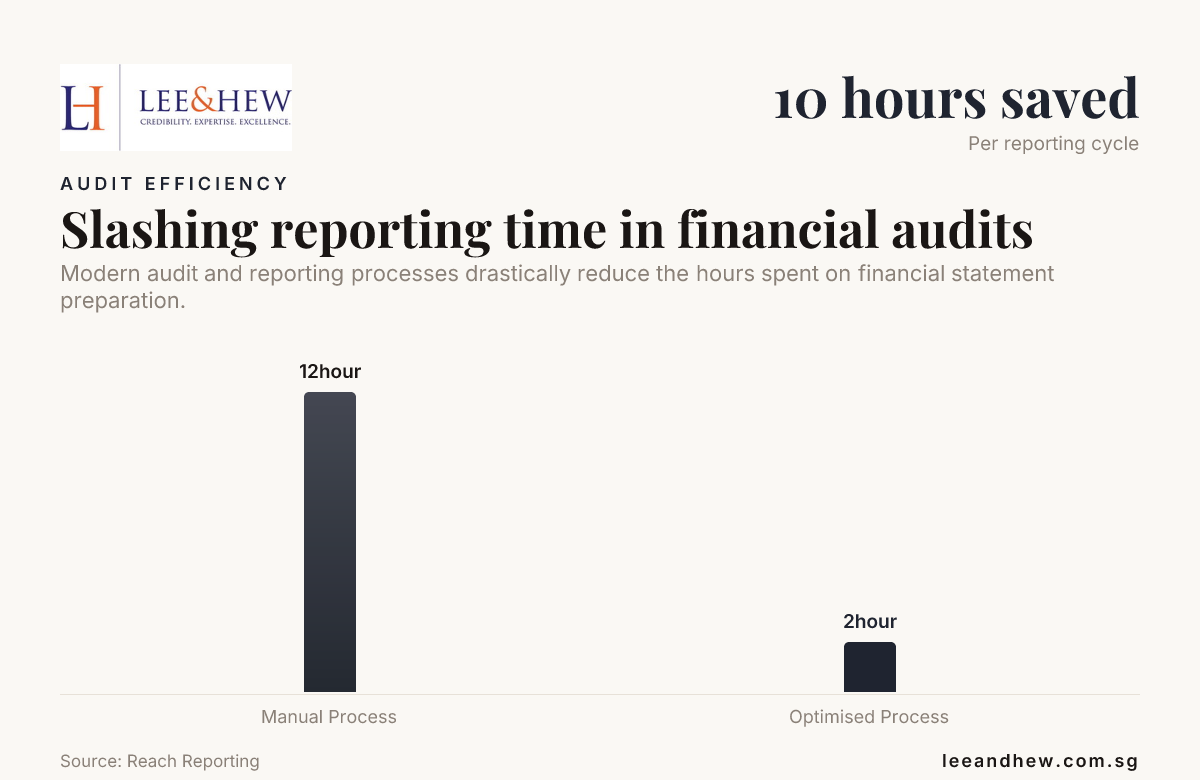 Modern audit and reporting processes drastically reduce the hours spent on financial statement preparation.
Businesses that modernise their accounting processes have reported cutting reporting time from around twelve hours down to just two. That kind of efficiency gain frees up finance teams to focus on analysis rather than administration, which is exactly the outcome we aim for with every client-centric engagement.
Sales, Turnover and Revenue-Focused Audits
Not every audit is purely about the balance sheet. A sales or gross turnover audit examines your company’s revenue records to verify that reported figures match actual transactions.
This matters enormously for businesses with revenue-linked leases, franchise arrangements or GST obligations, where IRAS and landlords alike want assurance that the numbers reported are the numbers actually earned. Our piece on sales and gross turnover audits covers the tax and leasing implications in full.

Common Pitfalls in Financial Audits (and How to Avoid Them)
Audit pitfalls differ from simple mistakes because they are recurring and stem from systemic issues rather than one-off errors. The two we encounter most often are incomplete documentation and weak internal controls.
Incomplete documentation undermines the audit process and can lead to penalties and damaged credibility with ACRA and other regulators. Weak internal controls, meanwhile, often surface during risk assessment and can extend the fieldwork stage considerably.
- Maintain organised, complete records throughout the year, not just before the audit.
- Reconcile bank accounts and inter-company balances monthly rather than annually.
- Document key judgements and estimates as they are made, not retrospectively.
- Engage your auditor early on any significant transactions or restructuring.
How Audits Build Business Transparency and Investor Trust
Audits create a direct connection between accurate financial reporting and investor confidence by providing independent verification of company records. When auditors sign off on statements, they stake their professional reputation on the results, which is precisely why an audit opinion carries so much weight.
The audit process also identifies weak spots in company systems, helping businesses fix problems before they escalate into something more serious. Auditors who function as trusted advisors move beyond simple compliance checks and help management strengthen the systems behind the numbers, not just the numbers themselves.
Our full discussion on how audits ensure business transparency explores this trusted-advisor relationship in greater detail.
Beyond Compliance: Special Audits That Add Value
Not every audit is statutory. Special audits, whether forensic, due diligence or acquisition-related, can add genuine value well beyond satisfying a regulatory obligation.
These engagements often surface operational inefficiencies or control gaps that a standard statutory audit would not necessarily uncover. Our article on how special audits add value to your organisation explains where these engagements fit alongside your regular compliance obligations.

Choosing the Right Audit Services Singapore Provider
The firm you choose matters more than most directors realise at the outset. A firm offering genuine Audit Services Singapore businesses can depend on should combine technical competence with a service attitude that treats your business as a partnership, not a transaction.
Led by the founders, entrenched with a service attitude, grounded with technical competence & integrity and with a deep sense of humility, Lee & Hew has continued to grow and has never looked back since starting as a small practice back in 2013. Our integrated suite of services, spanning accounting, audit, tax, and company secretarial support, is designed to ensure that every element of your financial governance is aligned.
We also maintain a dedicated Financial Services Practice for clients with more specialised regulatory needs, and our membership in the ETL Global network means local expertise is always backed by international reach. Explore the full range of what we offer on our services page.
We act as your outsourced Compliance Officer so that you can be assured that you are compliant all the way.
Understanding Financial Statement Audits in Singapore Going Forward
This Ultimate Guide to Understanding Financial Statement Audits in Singapore should leave you with a clearer picture of what an audit involves, who needs one, and why the process rewards preparation over panic. From group and subsidiary structures to stand-alone statutory audits, the fundamentals stay consistent: independent verification, adherence to FRS/IFRS, and a genuine focus on stakeholder trust.
With a keen eye on details and international expertise, Lee & Hew provides comprehensive, customised solutions for every stage of your audit journey. Enhancing your credibility through our Audit & Assurance services remains at the core of what we do, and we would be glad to talk through what your next audit cycle should look like.
Frequently Asked Questions
What is the difference between a financial statement audit and a tax audit in Singapore?
A financial statement audit examines whether your accounts present a true and fair view under FRS or IFRS, while a tax audit is carried out by IRAS to check your tax filings and GST compliance. They serve different regulators and different purposes, though findings from one can influence the other.
Do all companies in Singapore need an annual audit?
No, small companies meeting the exemption criteria under the Companies Act may be exempt from statutory audit. Many still opt for a voluntary audit to satisfy banks, investors or joint venture partners.
How long does a typical financial statement audit take?
Timelines vary with company size and complexity, but a well-prepared stand-alone audit often takes a few weeks from fieldwork to final report. Group audits with multiple subsidiaries generally take longer due to consolidation and coordination with component auditors.
What documents should I prepare before an audit?
You should have your general ledger, bank reconciliations, supporting invoices, contracts, and prior year financial statements organised and ready. Incomplete documentation is one of the most common pitfalls that delays an audit timeline.
Is a group audit more expensive than a stand-alone company audit?
Generally yes, because group audits involve consolidation, coordination with component auditors across subsidiaries, and additional risk assessment at both group and entity level. The exact scope depends on how many subsidiaries are involved and where they are located.
What happens if my company fails an audit or receives a qualified opinion?
A qualified opinion means the auditor found specific issues that prevent a clean, unqualified sign-off, though it does not necessarily mean fraud or serious wrongdoing. It typically triggers further discussion with management, corrective action, and closer scrutiny in the following audit cycle.
Why should I use professional Audit Services Singapore firms instead of handling compliance internally?
Professional Audit Services Singapore providers bring independence, technical competence and up-to-date knowledge of ACRA and FRS/IFRS requirements that internal teams often lack the bandwidth to maintain. Engaging an experienced firm also strengthens credibility with investors, banks and other stakeholders who expect independently verified figures.
Created with AI assistance and reviewed by a human
Contact us now to find out more!