
Singapore captured nearly 60% of total venture capital deal volume in the ASEAN region, securing US$4.8 billion in a single year alone. That figure does not happen by accident. The best tax incentives for startups in Singapore are a core reason why founders, both local and international, continue to choose this city-state as their launchpad. Whether you are incorporating fresh or scaling fast, understanding these incentives is not optional. It is a statutory responsibility, and one that smart founders treat with the same seriousness as their product roadmap.

Key Takeaways
| Incentive / Topic | What You Need to Know |
|---|---|
| Startup Tax Exemption (SUTE) | Newly incorporated companies can claim 75% exemption on the first S$100,000 of chargeable income for the first three years of assessment. |
| Partial Tax Exemption (PTE) | Companies that no longer qualify for SUTE still benefit from a 75% exemption on the first S$10,000 of chargeable income. |
| Corporate Income Tax Rebate | IRAS periodically provides corporate tax rebates; recent rebates have been set at 25% of tax payable, subject to caps. |
| Enterprise Development Grant (EDG) | Qualifying startups can receive funding support for capability building, innovation, and internationalisation projects. |
| Double Tax Deduction for Internationalisation (DTDi) | Eligible expenses for market expansion and investment development activities may qualify for a 200% tax deduction. |
| GST Registration Threshold | Startups with annual taxable turnover below S$1 million are not required to register for GST, reducing early-stage compliance costs. |
| Professional Tax Support | Working with experienced tax professionals in Singapore ensures you claim every eligible incentive on time and in compliance. |
Why Singapore’s Tax Framework Is Built for Startups
Singapore operates on a territorial tax basis with a flat corporate tax rate of 17%. On paper, that rate is already competitive by global standards. In practice, the best tax incentives for startups in Singapore push the effective rate far below that headline figure during the critical early years of operation.
The Inland Revenue Authority of Singapore (IRAS) and Enterprise Singapore have designed the incentive framework to reward companies that incorporate locally, hire locally, and grow responsibly. That is a framework built on standards, not shortcuts.
From our experience working with SMEs and growing companies, founders who engage with these schemes early and correctly preserve capital that would otherwise leave the business unnecessarily. It is, fundamentally, all about the details.

Best Tax Incentives for Startups in Singapore: The Startup Tax Exemption (SUTE)
The Startup Tax Exemption scheme is the headline incentive for newly incorporated companies in Singapore. Under SUTE, a qualifying company pays zero tax on the first S$100,000 of chargeable income and 50% tax on the next S$100,000, for each of the first three Years of Assessment.
To qualify, your company must be incorporated in Singapore, be a tax resident in Singapore, and must not have more than 20 individual shareholders (with at least one individual shareholder holding a minimum of 10% of shares). Investment holding companies are excluded from this scheme.
The net result for a startup generating modest but meaningful early revenue is an effective corporate tax rate that is dramatically lower than 17%. That difference is working capital. It is runway. It is what keeps the lights on while your product matures and your team grows.
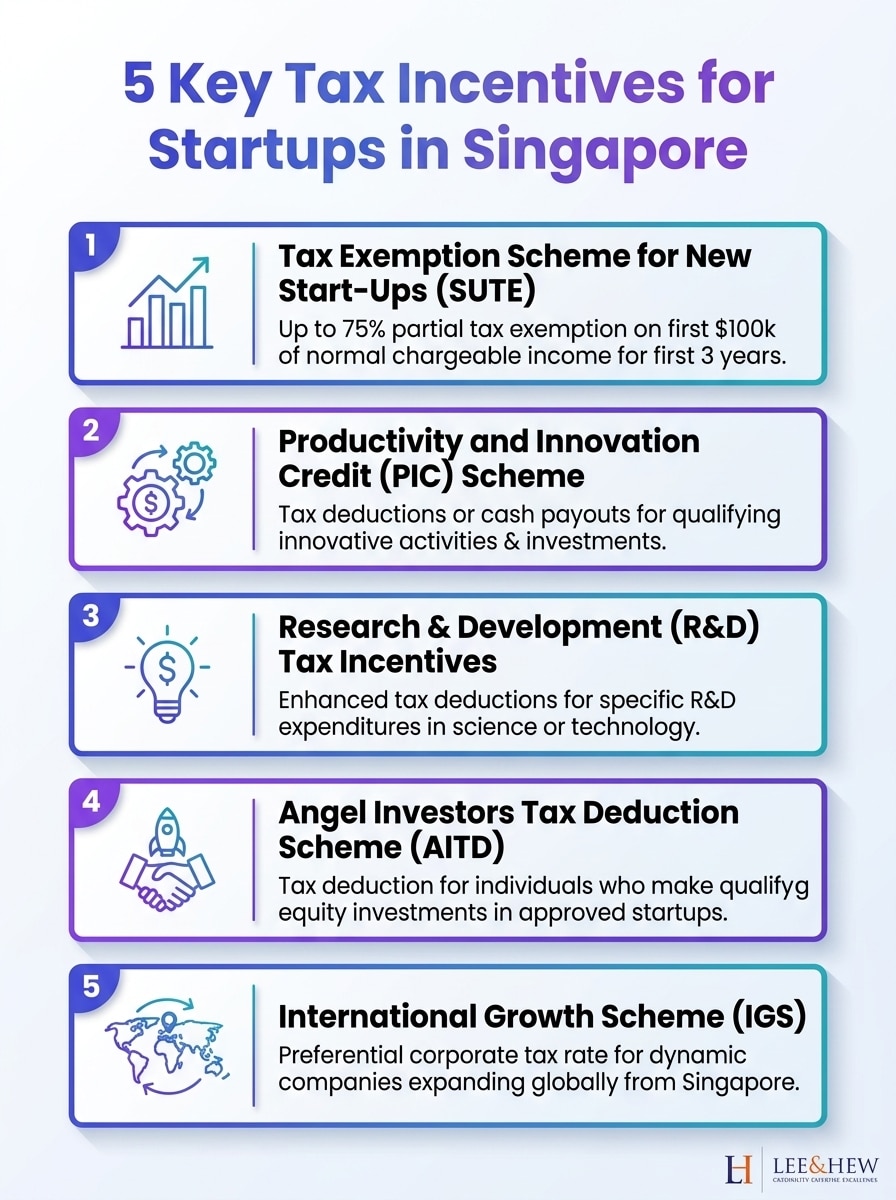 A quick visual guide to the five main tax incentives Singapore offers startups, helping founders save on early-stage costs.
Partial Tax Exemption: A Safety Net for Growing Companies
Once your company graduates out of the SUTE window (typically after the third Year of Assessment), the Partial Tax Exemption (PTE) takes over. This is the default exemption framework available to all qualifying Singapore-resident companies.
Under PTE, a 75% exemption applies to the first S$10,000 of normal chargeable income, and a 50% exemption applies to the next S$190,000. It is a more modest benefit than SUTE, but it is still a meaningful one, particularly for companies in the S$100,000 to S$300,000 profit range.
Many founders make the mistake of assuming that once SUTE expires, tax planning becomes less important. That assumption is costly. The transition from SUTE to PTE is precisely the moment when a structured Singapore tax strategy pays for itself many times over.
Corporate Income Tax Rebate: The Recurring Annual Benefit
In addition to the exemption frameworks described above, IRAS periodically announces a Corporate Income Tax Rebate applicable to a given Year of Assessment. Recent rebates have been set at 25% of tax payable, subject to a cap.
This rebate stacks on top of SUTE and PTE, further compressing the effective tax rate for compliant Singapore-incorporated companies. It is not a guaranteed annual measure, so startups should treat it as a welcome addition rather than a budget line item. However, for companies with competent tax professionals monitoring compliance on-time, claiming the rebate correctly is a straightforward process.
The rebate reinforces a broader point: Singapore’s tax incentive framework rewards companies that maintain clean books, file accurately, and engage with the system proactively. That is not a burden. That is the baseline expectation of a well-run business.

Best Tax Incentives for Startups in Singapore: The Double Tax Deduction for Internationalisation (DTDi)
For startups that are already looking beyond Singapore’s borders, the Double Tax Deduction for Internationalisation scheme is one of the most valuable tools available. Under DTDi, qualifying expenses incurred for approved overseas market development activities attract a 200% tax deduction.
Eligible expenses include overseas business development trips, participation in trade fairs, feasibility studies for overseas investments, and certain professional fees linked to internationalisation efforts. The scheme is administered jointly by Enterprise Singapore and the Singapore Tourism Board.
As a firm with ETL Global membership, we understand the value of cross-border operations firsthand. The DTDi scheme is how Singapore formally encourages its startups to compete globally while remaining headquartered locally. That alignment of policy and ambition is precisely what makes Singapore a compelling base for growth-stage companies.
Enterprise Development Grant and Other Growth-Stage Incentives
The Enterprise Development Grant (EDG), administered by Enterprise Singapore, provides funding support for projects that help companies grow, innovate, and internationalise. Qualifying costs include consultancy fees, software, and equipment directly tied to approved projects.
For startups with limited cash reserves but strong development roadmaps, the EDG can meaningfully reduce the net cost of strategic initiatives. The key is proper documentation and project scoping, areas where technical competence from an experienced adviser makes a real difference to your application outcome.
There are also sector-specific incentive schemes administered through the Economic Development Board (EDB), covering areas including intellectual property development, research and development expenditure, and pioneer status for companies in qualifying industries. Each comes with its own eligibility criteria and compliance requirements. None of them reward guesswork.

GST Considerations for Early-Stage Startups
Goods and Services Tax (GST) is a separate but closely related compliance area for startups. Companies with annual taxable turnover below S$1 million are not required to register for GST. This threshold gives early-stage businesses breathing room on the compliance front.
However, voluntary GST registration carries its own advantages, particularly for startups incurring significant GST on their inputs (such as equipment, software, or professional fees). Recovering input tax through voluntary registration is a legitimate and often-overlooked way to improve cash flow in the early months of operation.
Our tax professionals regularly guide startups through the GST registration decision, weighing the compliance cost against the input tax recovery benefit. This is not a one-size-fits-all calculation. It depends on your business model, your supplier base, and your projected growth trajectory. Being reasonable has got nothing to do with size, and that philosophy applies here too.
Why Audit Services Singapore and Tax Compliance Work Together
Tax incentives and audit readiness are two sides of the same coin. A startup claiming SUTE, DTDi, or any other incentive must be able to substantiate those claims with accurate, well-maintained financial records. That is where Audit Services Singapore becomes directly relevant to your tax position.
Statutory audits, where required, provide an independent verification of your financial statements. Even for exempt private companies that are not required to be audited, maintaining audit-ready accounts is a mark of sound governance and a precondition for raising investment, applying for grants, and withstanding IRAS scrutiny.
We provide Audit Services Singapore to both standalone entities and group structures, delivering the standard of independent assurance that regulators, investors, and counterparties expect. Honourable, Accountable, Trustworthy: those are not marketing words for us. They are the professional standards we apply to every engagement.

How Lee and Hew Supports Startups on Tax Incentives and Compliance
We are a combination of big accounting firm expertise and small accounting firm personalised touch. That positioning is not incidental. It is the reason startups and SMEs in Singapore trust us with their most sensitive financial responsibilities.
Our tax professionals work with you to ensure you are compliant with all your Singapore corporate tax obligations while advising you on the options available for your specific circumstances. We do not offer generic checklists. We offer structured, adviser-led guidance grounded in technical competence and delivered with a genuine You Perspective.
Whether you need help structuring your company to qualify for SUTE, documenting DTDi-eligible expenses, managing your GST position, or preparing for an IRAS query, our team provides end-to-end support. As a proud member of ETL Global, we bring international perspective to local compliance, which matters when your startup’s ambitions cross borders early.
We also offer outsourced accounting and bookkeeping services to keep your financial records accurate, current, and audit-ready at every stage. Because you cannot claim what you cannot substantiate, and our job is to make sure you can do both.
Common Mistakes Startups Make with Singapore Tax Incentives
The best tax incentives for startups in Singapore are genuinely accessible. But they are not self-executing. The following mistakes are consistently costly.
- Missing the SUTE eligibility window by not incorporating correctly from day one. The scheme applies from the first Year of Assessment, and a poor incorporation structure can disqualify you before you have even filed.
- Failing to document DTDi-eligible expenses properly at the time they are incurred. Retrospective documentation rarely satisfies IRAS requirements.
- Conflating revenue with chargeable income when estimating the benefit of SUTE or PTE. Tax-exempt amounts apply to net chargeable income, not gross revenue.
- Delaying GST registration decisions until the turnover threshold is breached, when voluntary registration could have recovered significant input tax over the preceding months.
- Treating tax compliance and audit services Singapore as separate disciplines rather than integrated functions. Audit-ready accounts are the foundation of credible tax positions.
These are not obscure failure modes. They are recurring patterns in startups that handle tax in-house without adequate technical competence on the team. The cost of engaging the right professionals is modest relative to the value preserved.
Best Tax Incentives for Startups in Singapore: What to Prioritise First
If you are at incorporation stage, the immediate priority is ensuring your company structure qualifies for SUTE. This means checking shareholder composition, residency status, and business activity classification before you file your first corporate tax return.
If you are post-SUTE, the priority shifts to maximising PTE, capturing any applicable corporate tax rebate, and evaluating whether DTDi applies to your internationalisation expenditure. At the same time, review whether your accounts are maintained to the standard required for grant applications and regulatory scrutiny.
The resources available at our Singapore tax resources hub provide further reading on specific schemes, rebates, and compliance obligations relevant to growing companies. Knowledge is the first step. Action is the second.

Begin Your Financial Journey
The best tax incentives for startups in Singapore are substantive, well-documented, and within reach of any properly incorporated company with accurate financial records. SUTE, PTE, DTDi, the Corporate Income Tax Rebate, and the broader grant landscape collectively create a tax environment that is genuinely founder-friendly by global standards.
But these incentives do not reward passivity. They reward preparation, technical competence, and the humility to work with advisers who understand the details that matter. At Lee and Hew, we bring all of that to every client engagement, whether you are a founder at day one or a growth-stage company navigating your fifth Year of Assessment.
Begin Your Financial Journey. The right time to structure your tax position correctly is always now, not later.
Reach out to our team through our full-serviced professional offerings and let us help you claim every incentive you are entitled to, on-time, on-target and within budget.
Frequently Asked Questions
What is the best tax incentive for startups in Singapore right now?
The Startup Tax Exemption (SUTE) remains the single most valuable tax incentive for newly incorporated Singapore companies, offering a 75% exemption on the first S$100,000 of chargeable income for each of the first three Years of Assessment. Combined with any applicable Corporate Income Tax Rebate, the effective tax rate for qualifying startups is significantly below the standard 17% corporate rate.
How long does the Startup Tax Exemption (SUTE) last in Singapore?
SUTE applies for the first three consecutive Years of Assessment from the year your company was incorporated. After the SUTE window closes, the Partial Tax Exemption (PTE) applies automatically, providing a reduced but still meaningful exemption on the first S$10,000 and next S$190,000 of chargeable income.
Can a Singapore startup claim both SUTE and the Corporate Income Tax Rebate?
Yes, the SUTE exemption and the Corporate Income Tax Rebate operate on different bases and can generally both apply in the same Year of Assessment. The rebate is calculated on tax payable after the SUTE exemption is applied, and it is subject to an annual cap announced by IRAS.
Do I need audit services in Singapore to claim startup tax incentives?
Not all startups are required by statute to undergo an annual audit, but maintaining audit-ready accounts is essential for substantiating any tax incentive claim under IRAS scrutiny. Professional Audit Services Singapore also strengthen your position when applying for grants, securing investment, and managing cross-border compliance obligations.
What expenses qualify under the Double Tax Deduction for Internationalisation scheme?
Qualifying expenses typically include costs for overseas business development trips, participation in approved overseas trade fairs, feasibility studies for market entry, and certain professional fees related to approved internationalisation activities. The scheme is jointly administered by Enterprise Singapore and the Singapore Tourism Board, and prior approval is required for certain qualifying activities.
Is GST registration compulsory for startups in Singapore?
Mandatory GST registration applies when your annual taxable turnover exceeds S$1 million. Below that threshold, registration is voluntary. However, voluntary registration can be advantageous for startups incurring significant GST on inputs, as it allows recovery of that input tax through the GST return process.
What happens if my startup misses out on SUTE due to incorrect incorporation structure?
If your company does not meet the SUTE eligibility criteria (such as having more than 20 shareholders or being an investment holding company), you will fall directly into the Partial Tax Exemption framework instead. This is why engaging qualified tax and corporate secretarial professionals at the point of incorporation is so important. Correcting structural issues after the fact is far more complex and costly than structuring correctly from the start.
Contact us now to find out more!