
The new maximum fine for failing to maintain or update statutory registers, such as the Register of Members or Register of Registrable Controllers, has jumped to S$25,000, and it takes effect as part of the CALA Act phase timing that resets governance obligations for directors and company secretaries from 6 May 2026. If your company has not reviewed its statutory registers, board processes, or share capital mechanisms in light of this reset, the time to do so is now, not after the compliance deadline has passed.

Key Takeaways
| Question | Answer |
|---|---|
| When does the CALA Act governance reset take effect? | The first tranche commences on 6 May 2026, following ACRA’s gazetted commencement notice on 16 April 2026. |
| What is the biggest compliance risk? | Failure to maintain statutory registers now carries a maximum fine of S$25,000 per breach. |
| How much preparation time did companies get? | Only three weeks between the gazette notice and the effective date, which is why early preparation matters. |
| Does the treasury share cap change? | No. The existing 10% holding cap for treasury shares continues to apply under the new selective off-market share acquisition mechanism. |
| How significant is this overhaul? | It is described as the most significant overhaul of Singapore’s company law in over a decade. |
| What compliance calendar should companies use? | A structured 30, 60, and 90-day action window is recommended to address immediate changes. |
| What comes after the first tranche? | Employers should also watch 1 July 2026, when further changes to retirement age rules and EP COMPASS renewals take effect. |
For companies reviewing their broader compliance obligations alongside the CALA Act phase timing, our corporate secretarial services team can walk you through what needs to change in your registers, resolutions, and filings.
What the CALA Act Phase Timing Actually Means for 6 May 2026
The Companies and Limited Liability Partnerships (Miscellaneous Amendments) Act, commonly referred to as the CALA Act, was passed by Parliament on 5 November 2025.
ACRA gazetted the commencement notice for the first tranche on 16 April 2026, giving directors and company secretaries just three weeks to prepare before the effective date of 6 May 2026.
In short, the CALA Act phase timing is not a single event. It is a rolling series of governance changes that companies, particularly those with complex share structures or multiple registrable controllers, need to track carefully.
This is the most significant reset of Singapore’s company law framework in over a decade, and it touches statutory registers, share buyback mechanisms, and the compliance responsibilities that directors and company secretaries carry personally.
Why Directors and Company Secretaries Cannot Afford to Wait
Being on-time and within budget for a compliance deadline does not happen by accident; it is the result of structured preparation that begins well before the effective date.
The CALA Act phase timing compresses what would normally be a longer transition window into a matter of weeks. Companies that wait until close to 6 May 2026 to review their registers risk falling on the wrong side of the new S$25,000 maximum fine.
We act as your outsourced Compliance Officer so that you can be assured that you are compliant all the way, from statutory register updates through to board resolution documentation.
- Directors carry personal exposure for lapses in statutory register maintenance.
- Company secretaries are expected to flag governance gaps proactively, not reactively.
- Boards should treat the CALA Act phase timing as a standing agenda item until all tranches are implemented.

The 30, 60, and 90-Day Compliance Calendar
A structured 30, 60, and 90-day action window is the most practical way to manage the CALA Act phase timing without scrambling at the last minute.
| Window | Priority Actions |
|---|---|
| First 30 days | Audit statutory registers (Register of Members, Register of Registrable Controllers) for accuracy and completeness. |
| Days 31 to 60 | Review share buyback mechanisms and confirm the 10% treasury share cap is correctly applied. |
| Days 61 to 90 | Update board resolutions, company secretary records, and internal governance policies to reflect the new obligations. |
Companies that have not yet mapped out their own version of this calendar should start with the resources in our company incorporation and formation library, which covers many of the foundational structures affected by this reset.
Statutory Registers: The Front Line of the Governance Reset
The Register of Members and the Register of Registrable Controllers sit at the heart of the CALA Act phase timing changes.
These registers must now be maintained and updated with a level of accuracy that leaves little room for administrative oversight. A lapse here is no longer a minor paperwork issue; it is a S$25,000 exposure per breach.
We recommend directors and company secretaries treat register maintenance as an ongoing discipline rather than an annual filing task. Building this into quarterly board reporting removes the risk of gaps slipping through unnoticed.
Share Buybacks and the Selective Off-Market Acquisition Mechanism
One of the more technical elements of the CALA Act phase timing concerns the new selective off-market share acquisition mechanism.
The existing 10% holding cap for treasury shares continues to apply, which is reassuring for companies already familiar with the current framework. However, the mechanics of how selective off-market acquisitions are documented and approved have changed, and this has major implications on the company’s accounting, audit, and reporting to investors and other stakeholders.
Companies with more complex capital structures, including unicorns, aspiring unicorns, and startups managing multiple funding rounds, should pay particular attention here. Competition today demands companies, particularly unicorns, aspiring unicorns or startups, to be creative to retain talent and attract investors, and share buyback flexibility often plays a role in that strategy.

Why Audit Services Singapore Providers Are Watching This Closely
When auditors sign off on statements, they stake their professional reputation on the results, and the CALA Act phase timing changes the underlying documents that auditors rely on to form their opinions.
Firms offering Audit Services Singapore businesses depend on need to factor these governance changes into their audit planning from the current financial year onward. Statutory registers, share buyback records, and board resolutions all feed into the audit trail, and any gaps created by the reset will surface during the audit process.
Auditors who function as trusted advisors move beyond simple compliance checks. They flag where the CALA Act phase timing creates new disclosure requirements or changes how transactions should be classified under FRS/IFRS.
Our own Audit Services Singapore team has already started reviewing client registers and share capital documentation ahead of the 6 May 2026 effective date, precisely because being on-time and within budget for an audit engagement does not happen by accident.
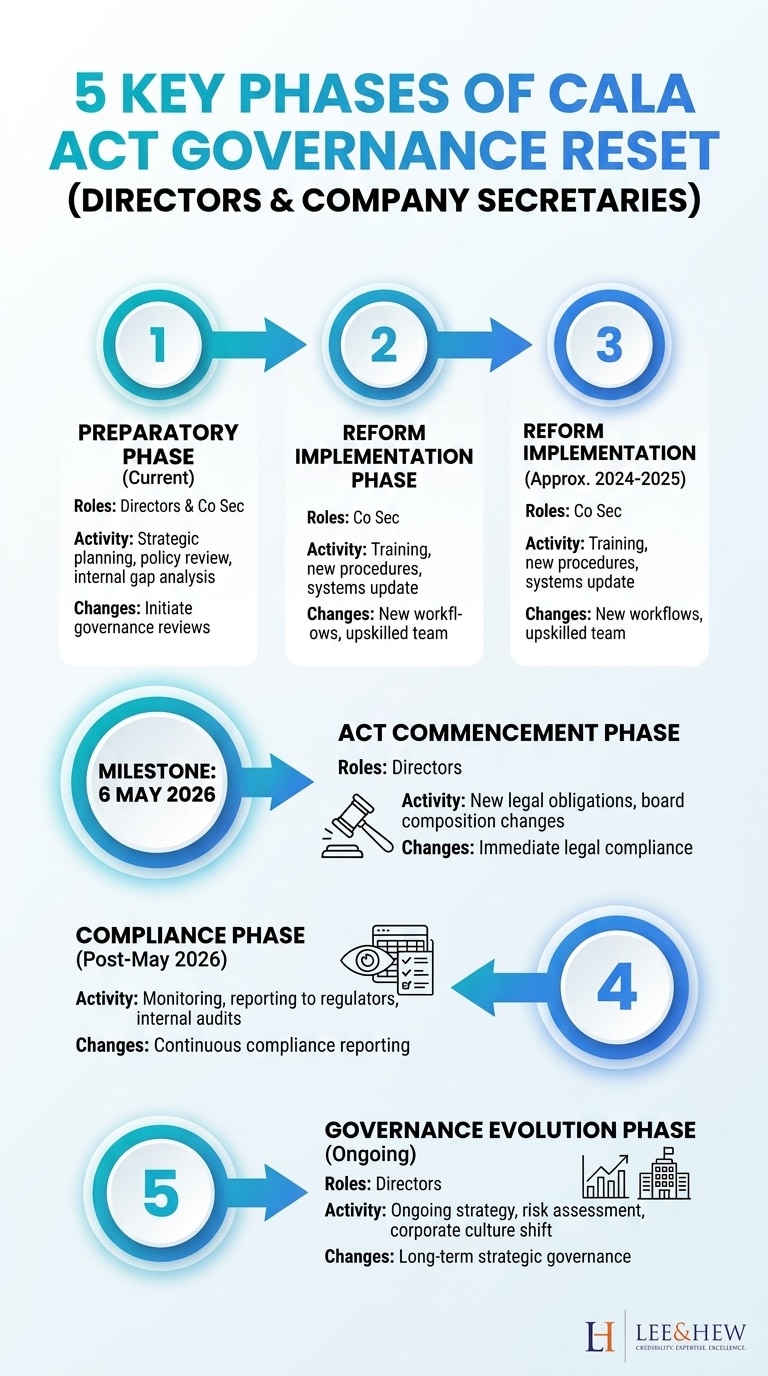
A visual roadmap of the CALA Act governance reset, detailing the 5 key phases for directors and company secretaries beginning 6 May 2026.
What Comes After 6 May 2026: Watch the 1 July 2026 Follow-On Changes
The CALA Act phase timing does not end on 6 May 2026. This is only the first tranche.
Companies should also mark 1 July 2026 on their compliance calendar, when additional significant changes for Singapore employers, including retirement age adjustments and EP COMPASS renewals, take effect.
These changes sit alongside the Corporate Service Providers Act 2024 framework, which began on 9 June 2025 and integrates with later tranches of the CALA Act. Directors and company secretaries who only focus on the 6 May date risk being caught off guard by this second wave of obligations.
Building a Governance Reset Checklist for Your Company
We have found that the companies who navigate the CALA Act phase timing most smoothly are the ones who build a checklist well before the deadline arrives.
- Confirm register accuracy. Review the Register of Members and Register of Registrable Controllers line by line.
- Review share capital mechanisms. Confirm treasury share holdings remain within the 10% cap and that selective off-market acquisition documentation is in order.
- Update board processes. Ensure resolutions and minutes reflect the new obligations under the reset.
- Coordinate with your auditor. Flag any changes early so your Audit Services Singapore provider can plan accordingly.
- Set calendar reminders. Track both the 6 May 2026 effective date and the 1 July 2026 follow-on changes.
In short, Lee & Hew looks after all aspects of your regulatory compliance, including the governance obligations that shift under the CALA Act phase timing.
Our integrated suite of services, spanning accounting, audit, tax, and company secretarial support, is designed to ensure that every element of your financial governance is aligned as these changes take hold. If you need a broader view of how this reset interacts with your existing structures, our full range of services page outlines how these pieces fit together.

How Lee & Hew Supports Directors and Company Secretaries Through This Reset
Led by the Founders, entrenched with a Service attitude, grounded with Technical Competence & Integrity and with a deep sense of Humility, Lee & Hew has continued to grow and has never looked back since our start in 2013.
With a keen eye on details and international expertise, Lee & Hew provides comprehensive solutions for the practical realities of the CALA Act phase timing, whether that means updating statutory registers, reviewing tax implications, or preparing for an upcoming audit.
Our membership in the ETL Global network means we combine local Singapore knowledge with global reach, which matters when your governance reset touches cross-border reporting or group structures. For companies also reviewing their tax position alongside this reset, our tax services team can advise on how the changes affect FRS/IFRS treatment and disclosure.
Genuine Governance Reset
The CALA Act phase timing marks a genuine governance reset for directors and company secretaries from 6 May 2026, and the compressed preparation window means companies cannot afford to treat it as a routine filing update.
From statutory register accuracy to share buyback mechanisms and the follow-on changes arriving on 1 July 2026, this reset touches nearly every corner of corporate compliance. Lee & Hew is all about delivering quality solutions on-time, on-target and within budget, for all your Audit, Accounting, Tax, Company Secretarial and Advisory needs, and we are ready to help you work through the CALA Act phase timing with confidence.
Frequently Asked Questions
What is the CALA Act phase timing and when does it start?
The CALA Act phase timing refers to the rolling implementation of Singapore’s Companies and Limited Liability Partnerships (Miscellaneous Amendments) Act, with the first tranche effective from 6 May 2026. It represents the most significant overhaul of Singapore’s company law in over a decade.
What happens if my company misses the 6 May 2026 deadline?
Companies that fail to maintain or update statutory registers, such as the Register of Members or Register of Registrable Controllers, face a maximum fine of S$25,000 per breach. Acting before the deadline is far less costly than correcting issues afterward.
Does the CALA Act change the treasury share buyback rules?
The existing 10% holding cap for treasury shares still applies, but the CALA Act introduces a new selective off-market share acquisition mechanism that changes how these transactions are documented and approved.
How much time did companies have to prepare for the 6 May 2026 reset?
ACRA gazetted the commencement notice on 16 April 2026, giving directors and company secretaries only three weeks before the effective date. This is why early preparation and a structured compliance calendar matter so much.
Are there more CALA Act changes coming after 6 May 2026?
Yes. Further significant changes for Singapore employers, including retirement age rules and EP COMPASS renewals, take effect on 1 July 2026, alongside the ongoing rollout of the Corporate Service Providers Act 2024 framework.
Should I involve an Audit Services Singapore provider before the deadline?
Yes. Involving an Audit Services Singapore provider early ensures your statutory registers, share capital records, and board resolutions are audit-ready under the new CALA Act requirements, rather than discovering gaps during the audit itself.
Is the CALA Act phase timing worth taking seriously for smaller companies in 2026?
Absolutely. The S$25,000 maximum fine and the personal compliance exposure for directors and company secretaries apply regardless of company size, so smaller entities face the same governance reset obligations as larger groups.
Contact us now to find out more!