
Understanding the top benefits of voluntary audits for growing Singapore SMEs has never been more strategically important than it is now. Consider this: 74% of SME loan applications were approved in 2025, a recovery from a five-year low, and the single most effective way your business can participate in that trend is to provide banks with independently verified financial data through a voluntary audit.
Key Takeaways
| Question | Answer |
|---|---|
| What is a voluntary audit for an SME in Singapore? | A voluntary audit is an independent examination of your financial statements conducted by a licensed public accounting firm, even when the Companies Act does not legally require it for your entity size. |
| Which SMEs are exempt from statutory audits in Singapore? | Small companies with annual revenue under S$10 million, total assets under S$10 million, and fewer than 50 employees qualify for the audit exemption under the Companies Act. |
| Does a voluntary audit help with bank loans? | Yes. Audited financials give banks independently verified data, which directly strengthens your loan application and can reduce processing delays significantly. |
| How do voluntary audits support investor attraction? | Investors rely on audited accounts to make funding decisions. Presenting audited financials signals accountability, transparency, and governance maturity to both local and international investors. |
| Are voluntary audits cost-effective for growing SMEs? | Yes. Reputable audit services in Singapore deliver value-adding audits on-time, on-target, and within budget, making the investment proportionate to the business benefits gained. |
| Can a voluntary audit improve internal processes? | Absolutely. A well-executed audit identifies process inefficiencies, control weaknesses, and financial risks that management may not have spotted through day-to-day operations. |
| What type of firm should I choose for a voluntary audit? | Choose an ACRA-licensed public accounting corporation with demonstrable industry expertise and a structured audit quality methodology, rather than simply the lowest-cost provider. |
What Is a Voluntary Audit and Why Does It Matter for Singapore SMEs?
A voluntary audit is exactly what the name suggests: your business chooses to have its financial statements independently examined by a licensed auditor, even when Singapore’s Companies Act does not compel you to do so.
For a growing SME, this decision is almost never about compliance alone. It is about strategic positioning.
Under Singapore’s small company exemption framework, many SMEs fall below the threshold that triggers mandatory statutory audits. This gives owners a choice, and the businesses that choose voluntary audits consistently gain a measurable competitive edge over those that do not.
The reasons span credibility, financing, risk management, investor relations, and operational improvement. We will walk through each of these in detail below, because understanding the full picture is what helps you make the right call for your business.
Top Benefits of Voluntary Audits for Growing Singapore SMEs: Building Credibility and Trust
One of the most immediate and tangible top benefits of voluntary audits for growing Singapore SMEs is the credibility that audited accounts provide to every stakeholder your business interacts with.
Banks, suppliers, landlords, major clients, and potential partners all look at your financial statements through a lens of skepticism unless those numbers have been independently verified.
An audit does exactly that. It provides an independent, professional opinion that your financials present a true and fair view. This is not simply a formality; it is a trust signal that can make the difference between winning or losing a large contract, securing better payment terms from a supplier, or passing a vendor qualification process.
In industries such as Shipping, Logistics, Retail, IT, and Financial Services, where due diligence is standard practice before any significant commercial relationship is formalised, presenting audited accounts can move your business to the front of the queue.
“Enhancing your credibility is not a by-product of a good audit. It is one of its primary outputs.”
A distinguished audit firm delivers more than a signed report. It delivers a reputational endorsement that your financial governance meets professional standards, and that matters enormously when your SME is competing against larger, better-known players.
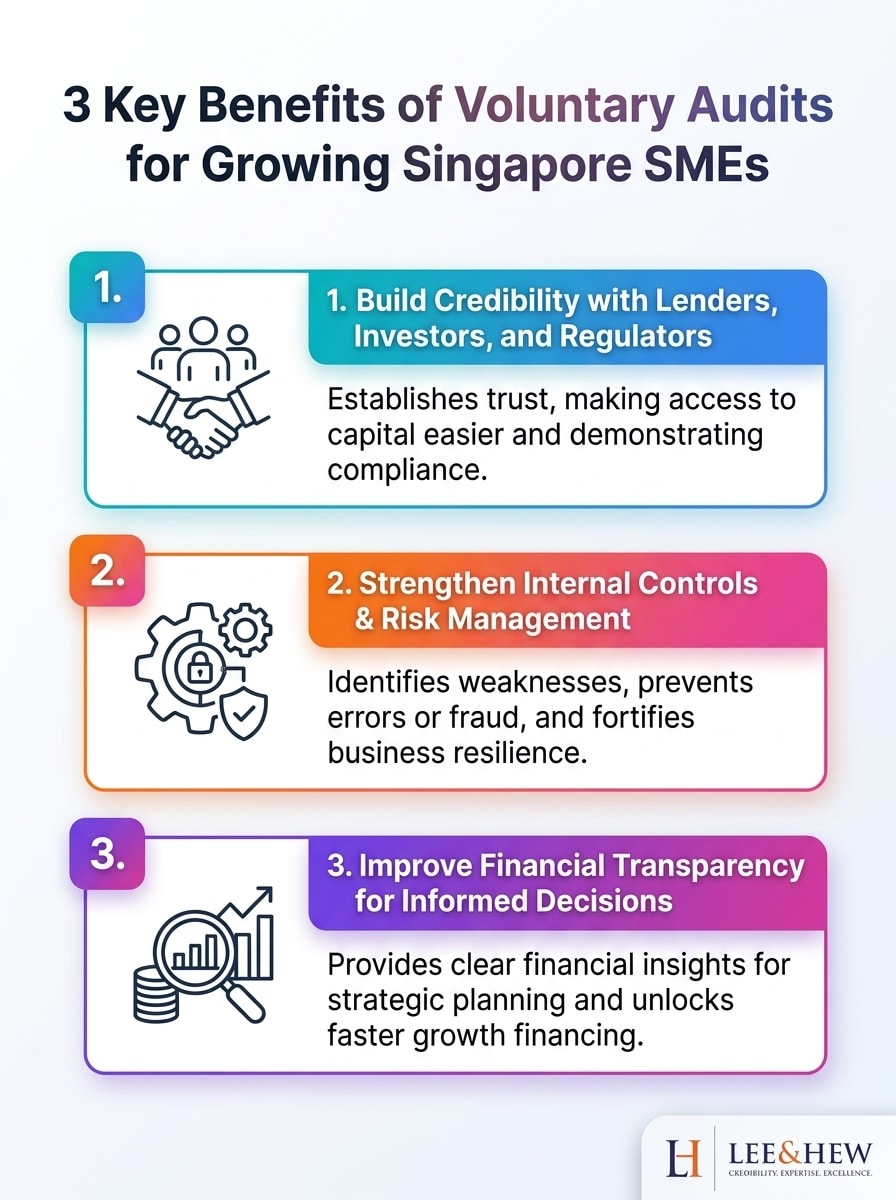 A concise visual guide to the top benefits of voluntary audits for growing Singapore SMEs. Learn how audits boost credibility, mitigate risk, and support growth opportunities.
How Voluntary Audits for Singapore SMEs Improve Access to Bank Financing
Securing bank financing is one of the most common growth challenges facing Singapore SMEs. Even with loan approval rates recovering, the process of getting from application to approval remains demanding, and your financial documentation is the single biggest variable within your control.
Banks and financial institutions require confidence that the numbers you present are accurate. Unaudited management accounts, no matter how carefully prepared, do not carry the same weight as independently verified financials.
When you submit audited accounts as part of a loan application, you are effectively removing one of the bank’s primary sources of doubt. This can lead to faster processing, more favourable terms, and access to larger credit facilities than your unaudited peers can typically obtain.
This data point matters directly to SME owners. If loan processing is taking over a month on average, every piece of documentation that accelerates a bank’s internal review reduces your waiting time and your business uncertainty.
Voluntary audits act as a financial pre-clearance. They signal to lenders that your accounts have already been put through a rigorous, independent verification process, reducing the bank’s own due diligence burden and smoothing the path to approval.
For growing businesses that rely on timely access to credit to fund inventory, expansion, or working capital, this is not a minor administrative advantage. It is a meaningful operational benefit.

Risk Management: A Core Benefit of Voluntary Audits for SMEs
Growing businesses often move fast, and fast growth can mask underlying financial risks that are difficult to see from inside the business.
A well-conducted voluntary audit surfaces these risks before they become serious problems. Common findings include revenue recognition inconsistencies, unrecorded liabilities, weaknesses in internal controls, and transaction errors that have accumulated over time without detection.
This is not a criticism of a business’s management team. It reflects the reality that many SMEs are running lean operations where the same people are managing finance, operations, and customer relationships simultaneously.
An independent auditor brings a structured, methodical review process that is specifically designed to identify what might be missed in day-to-day operations. The output is not just a signed report; it is practical, actionable insight that management can use to strengthen the business.
This is precisely the value-adding approach that distinguishes a high-quality audit from a purely tick-box exercise. The best audit firms treat the engagement as a genuine business advisory interaction, not simply a documentation review.
- Identification of internal control weaknesses before they lead to financial loss
- Detection of errors in financial reporting before they compound over multiple periods
- Assessment of compliance with Singapore Financial Reporting Standards (SFRS)
- Insight into where operational processes could be tightened to reduce financial risk
- Documentation of financial governance that protects directors in the event of disputes or regulatory scrutiny
For SMEs in regulated sectors such as Fintech, Financial Services, and Fund Management, the risk management dimension of a voluntary audit is particularly valuable because it aligns your financial governance with the expectations of your regulatory environment.
Voluntary Audit Benefits for Singapore SMEs Seeking Investment
If your growth strategy includes attracting external investment, whether from angel investors, venture capital, private equity, or strategic partners, audited financials are not optional. They are expected.
Sophisticated investors conduct thorough due diligence before committing capital. The first thing they ask for is financial statements, and the second thing they ask is whether those statements have been audited.
Presenting unaudited accounts to an investor creates an immediate obstacle. It introduces doubt about the accuracy of your numbers and raises questions about your governance maturity. Even if your financials are entirely accurate, the absence of independent verification is a red flag that can slow negotiations or reduce your valuation.
Voluntary audits remove that obstacle entirely. They demonstrate that your business is accountable, transparent, and run with the kind of financial discipline that investors can rely on when they write a cheque.
This is especially relevant for startups and aspiring high-growth companies. Complex accounting challenges around equity compensation, revenue recognition for software or subscription models, and multi-round financing structures all benefit significantly from having a professional audit framework in place from early stages.
Establishing audited accounts early also means your financial history is clean and credible when the time comes for a more significant capital raise. Investors and acquirers place a premium on businesses with well-documented, consistently audited financials, and that premium directly affects what your business is worth at exit.
How Professional Audit Services Singapore Supports Regulatory Confidence
Singapore’s regulatory environment is among the most respected in Asia for good reason. ACRA, IRAS, and MAS all operate with high standards, and businesses that maintain audited accounts are better positioned to navigate regulatory interactions with confidence.
When IRAS reviews a tax filing or ACRA examines corporate governance, a business with independently audited financials demonstrates a level of preparedness that regulators respond to positively.
This is particularly relevant for SMEs in growth phases, where changes in business structure, new revenue streams, or international expansion can create regulatory complexity that requires precise financial documentation.
Professional audit services in Singapore go beyond producing a report. They ensure that your financial statements are prepared in accordance with Singapore Financial Reporting Standards, that your accounting treatments are defensible, and that your disclosures meet the standards expected by regulators and stakeholders alike.
For SMEs considering international expansion, particularly into markets across Southeast Asia, having a track record of audited financials prepared under recognised standards is a prerequisite for regulatory approval in many jurisdictions.
The ability to walk into any regulatory conversation with clean, independently verified accounts is a form of protection that growing SMEs consistently underestimate until they need it.
Voluntary Audits as a Foundation for Scaling Beyond Singapore
Many of the top benefits of voluntary audits for growing Singapore SMEs become even more significant when you look beyond the local market.
Regional expansion into Malaysia, Indonesia, Thailand, or further afield involves opening new entities, navigating foreign regulatory requirements, and often working with local banks, joint venture partners, or government agencies who will want to see your financial track record.
A history of audited accounts from a reputable Singapore firm provides exactly that track record. It gives international counterparts the assurance they need to transact with confidence, and it demonstrates that your business operates to a standard that is recognised across the region.
This is one area where being connected to a global network makes a practical difference. Access to professional relationships across multiple jurisdictions means that expanding SMEs can get consistent, coordinated support rather than starting from scratch in every new market they enter.
Regional expansion also often requires consolidated financial reporting, which is a more complex undertaking than standalone company accounts. Having a solid audit foundation in place from early stages makes the transition to group-level reporting significantly smoother when the time comes.
Operational Improvements That Come with Voluntary Audits for SMEs
Beyond the external-facing benefits, voluntary audits deliver something that many SME owners underestimate: a structured review of how your business actually records, manages, and reports its financial data.
The audit process naturally prompts businesses to review and improve their internal accounting workflows. In preparation for an audit, most businesses tighten their bookkeeping, reconcile accounts they may have left unattended, and resolve discrepancies that have been sitting in the books unchecked.
This preparation work alone has operational value. But the audit itself goes further, identifying where your processes could be more efficient, where your controls could be stronger, and where your documentation could be more complete.
Growing businesses often rely heavily on their accounting and finance teams carrying institutional knowledge in their heads rather than documented processes. A voluntary audit encourages the formalisation of these processes, which reduces key-person dependency and builds a more resilient financial operation.
For SMEs that use outsourced accounting and bookkeeping services, a voluntary audit also provides an independent check on the quality and accuracy of the work being delivered, giving business owners additional assurance that their financial records are in order.
When the audit is conducted by a team that genuinely treats the engagement as value-adding rather than purely compliance-focused, management walks away with practical observations and recommendations that improve the business, not just a signed report.

Choosing the Right Audit Services Singapore for Your SME
The quality of the audit experience and the value you extract from it depends significantly on the firm you choose.
Not all audit firms approach SME engagements with the same depth of expertise or commitment to quality. The key factors to look for include ACRA licensure, demonstrable experience in your industry, a structured audit methodology, and a genuine commitment to delivering practical value rather than just completing documentation.
For SMEs with more complex structures, such as those with multiple related entities, foreign shareholders, or group reporting requirements, it is also important to choose a firm that has specific group audit capability rather than limiting themselves to standalone company audits.
The breadth of services available from your audit firm also matters for growing businesses. Having access to complementary tax services in Singapore under the same roof creates a joined-up approach where your audit findings inform your tax planning and vice versa, avoiding the fragmented advice that comes from working with multiple disconnected providers.
Industry-specific experience is another important consideration. Audit firms that have worked extensively in your sector understand the specific accounting treatments, regulatory requirements, and business model characteristics that apply to your business, which makes the audit process faster, more accurate, and more genuinely useful.
You can explore the full range of integrated professional services available to find a firm that can support your audit needs alongside your broader accounting, tax, and compliance requirements.
Industry-Specific Voluntary Audit Considerations for Singapore SMEs
The specific benefits of a voluntary audit vary somewhat depending on the industry your SME operates in, and it is worth understanding how the advantages apply in your particular context.
Retail and Trading businesses benefit most from audits that rigorously examine inventory valuation, cost of goods sold, and revenue recognition. These are areas where errors can accumulate silently and distort management’s understanding of actual margins and profitability.
Shipping and Logistics companies often deal with complex revenue recognition questions around long-term contracts, variable freight charges, and cross-border transactions. An audit provides assurance that these are being handled correctly under applicable accounting standards.
IT and Technology SMEs frequently face questions around software revenue recognition, contract accounting, and the treatment of development costs. Investors and acquirers in this sector are particularly attentive to whether these items have been properly accounted for.
Financial Services firms, even smaller ones, operate in a regulatory environment where audited accounts are effectively a baseline expectation for maintaining credibility with counterparties, regulators, and clients.
Understanding which audit-related issues are most relevant to your sector is part of why working with a firm that has genuine industry depth makes a measurable difference. You can explore sector-specific considerations across a range of industries and specialties to understand how professional audit services apply to your business context.
The audit resources and insights available from experienced practitioners can also help you stay current with regulatory developments that may affect your voluntary audit approach.
Conclusion
The top benefits of voluntary audits for growing Singapore SMEs are both broad and substantial. From building stakeholder credibility and improving access to bank financing, to managing risk proactively, attracting investment, supporting regulatory confidence, and laying the groundwork for regional expansion, a well-executed voluntary audit delivers value that extends well beyond the audit report itself.
For SMEs that are serious about growth, the question is not really whether a voluntary audit is worth it. The question is how quickly you can put one in place so that your business captures these advantages before your competitors do.
The right audit services in Singapore will approach your engagement with the depth, honesty, and practical orientation your business deserves, on-time, on-target, and within budget, with findings that genuinely help you build a stronger, more credible, and better-governed business.
If you are ready to explore how a voluntary audit can support your growth plans, we are here to help. Learn more about our audit services and begin your financial journey with a team that combines Big 4 pedigree with a personal, client-first approach.
Frequently Asked Questions
Is a voluntary audit worth it for a small Singapore SME?
Yes, for most growing SMEs, a voluntary audit is worth the investment. The top benefits of voluntary audits for growing Singapore SMEs, including improved financing access, stronger investor credibility, and risk identification, consistently outweigh the audit fee, particularly as your business scales and the stakes of financial errors increase.
What is the difference between a voluntary audit and a statutory audit in Singapore?
A statutory audit is legally required under the Companies Act for companies that do not qualify as small companies. A voluntary audit is a business’s own decision to have its financials independently verified even when not legally compelled to do so. Both produce the same output: an auditor’s independent report on your financial statements.
How do audited accounts help Singapore SMEs get bank loans faster?
Audited accounts provide banks with independently verified financial data, which reduces the bank’s own internal due diligence burden and increases the reliability of the information you submit. With bank loan processing times stretching beyond 30 days on average in 2025, having pre-verified financial documentation gives your application a meaningful head start.
Can a voluntary audit help my SME attract investors or venture capital?
Yes. Investors expect audited financials as part of their due diligence process, and presenting unaudited accounts immediately raises questions about governance maturity. Voluntary audits for Singapore SMEs seeking investment demonstrate financial accountability and transparency, two qualities that investors prioritise when evaluating early-stage businesses.
How often should a growing Singapore SME get a voluntary audit done?
Most growing SMEs benefit from annual voluntary audits, aligned with their financial year-end. Annual audits ensure that your financial statements remain current, your investor and lender relationships are supported by up-to-date verified data, and any emerging risks are caught before they compound across multiple periods.
What should I look for when choosing an audit firm in Singapore for my SME?
Look for an ACRA-licensed firm with demonstrable experience in your industry, a structured audit quality methodology, and a genuine commitment to delivering value-adding observations rather than just completing paperwork. Access to complementary tax and accounting services under the same roof is also a significant practical advantage for growing businesses.
Do voluntary audits help Singapore SMEs that are planning to expand regionally?
Absolutely. A history of audited accounts from a reputable Singapore firm provides the financial track record that foreign banks, regulators, and business partners require when you enter new markets. The top benefits of voluntary audits for growing Singapore SMEs with regional ambitions include stronger cross-border credibility and a solid foundation for group-level financial reporting as your structure becomes more complex.
Contact us now to find out more!