
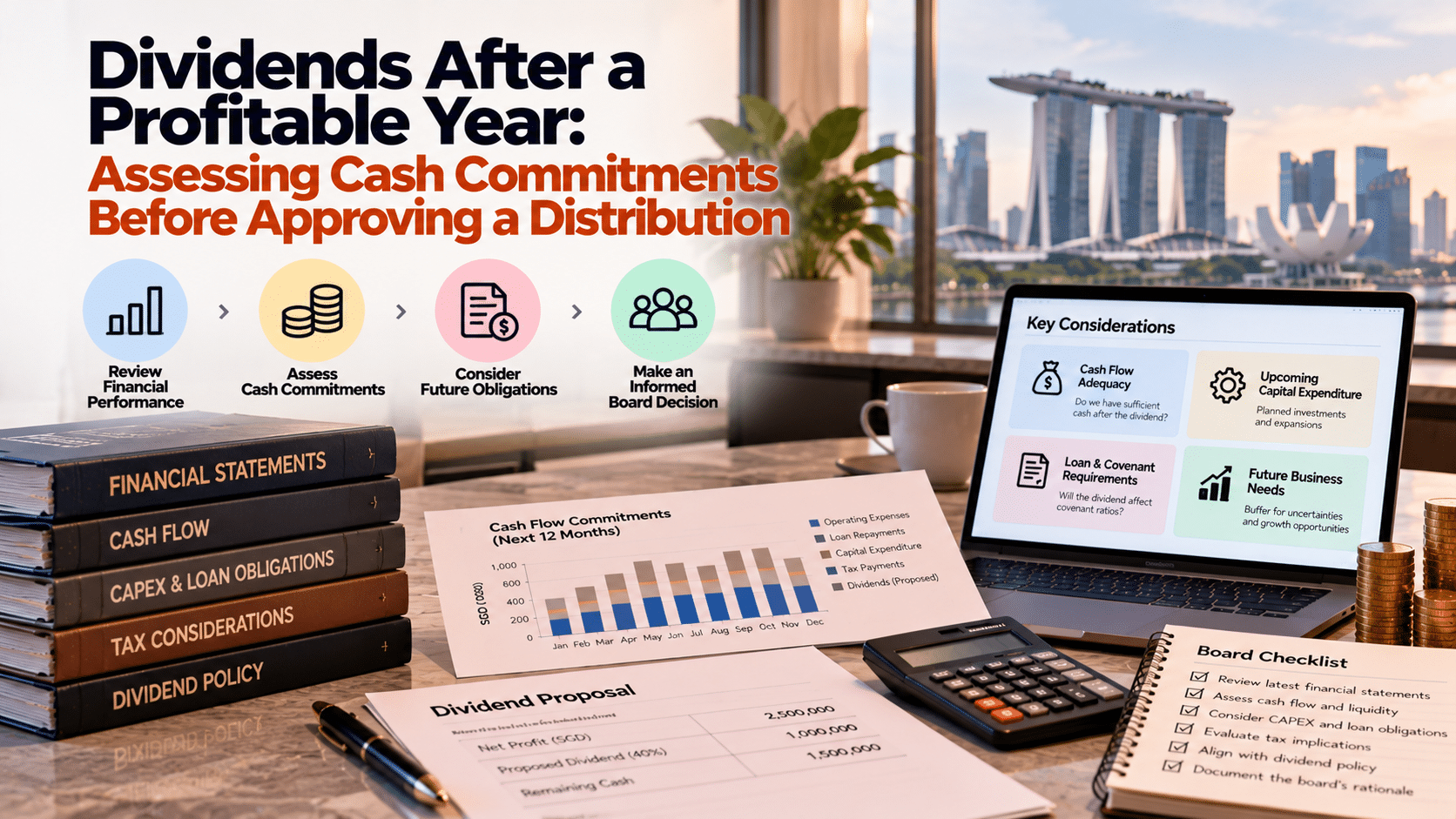
A profitable year naturally raises expectations of a dividend. Shareholders have committed capital, management has delivered results, and the financial statements show a return from the business. A distribution may be appropriate, but the amount should not be determined by the annual profit figure or bank balance alone.
Profit, cash and the company’s capacity to meet future commitments answer different questions. Revenue may remain uncollected, suppliers may be awaiting payment, and funds may already be needed for equipment, tax or seasonal stock purchases. A dividend that appears comfortable at year-end can create pressure several months later.
Lee & Hew provides accounting, tax and corporate secretarial services, including support for group structures and holding companies. Bringing reliable financial information into the dividend discussion helps directors assess both the basis for a distribution and its effect on the business. The objective is a supported decision that recognises shareholder returns alongside the company’s continuing obligations.
Establish the Basis for a Dividend First
In Singapore, section 403 of the Companies Act provides that dividends are payable only out of profits. Cash availability alone does not establish that a dividend is permissible. Borrowing money or receiving a large customer deposit can increase the bank balance without creating profits available for distribution.
Review the company’s financial position and the basis for the proposed dividend with the relevant accounting and corporate secretarial advisers. A single current-year profit figure should not be treated as the answer without considering the company’s circumstances and the nature of the balances involved.
The approval process must also reflect the company’s constitution, share rights and applicable requirements. Confirm the appropriate procedure for the proposed distribution rather than assuming that every dividend follows the same steps.
Establishing the legal and corporate basis is distinct from deciding how much cash the business can comfortably release. Both assessments are necessary, and neither substitutes for the other.
Use Financial Information That Is Current Enough
Annual financial statements provide an important foundation, but circumstances can change between the reporting date and the proposed distribution. A major customer may have delayed payment, trading may have weakened or management may have committed to an expansion.
Prepare recent management accounts and reconcile material balances before the decision. Review outstanding adjustments, unusual movements and any matters that could change the reported position. Directors should understand whether the figures are final, provisional or dependent on significant estimates.
ACRA’s guidance makes clear that directors retain responsibility for financial reporting even where external assistance is used. That includes reading and questioning information rather than relying solely on the fact that an accountant prepared it.
A concise update covering developments since year-end can help the board focus. It should explain changes in trading, collections, borrowing and commitments that affect the proposal, with supporting detail available for significant items.
Explain Why Profit Has Not All Become Cash
A profitable company may have substantial resources tied up in working capital. Sales can be recognised before customers pay, while stock purchases and advance supplier payments consume cash before the related revenue is earned.
Prepare a bridge between the reported result and cash movements. Identify the effect of receivables, inventory, supplier balances, capital expenditure and financing payments. This explains why a strong profit does not necessarily leave an equivalent amount available in the bank.
The reverse is also possible. Cash may look unusually strong because supplier payments fall just after year-end or customers have paid in advance. Those timing benefits should be visible in the dividend review.
Directors do not need to examine every transaction to understand the position. They do need a clear explanation of the major differences, particularly where a temporary cash surplus is being presented as evidence that a large distribution is affordable.
Build a Dated Forecast of Commitments
A cash forecast should show when receipts and payments are expected, not simply annual totals. Include payroll, suppliers, tax payments, debt servicing and other recurring obligations, together with significant purchases or projects.
Use a period that captures the company’s operating cycle and material commitments. A business preparing for a seasonal stock build-up may need a longer view than a stable service company with predictable monthly collections. Weekly detail may be useful around a tight payment period.
Distinguish committed expenditure from discretionary plans. An equipment order already placed differs from an idea that management has not approved. Both can inform the decision, but their flexibility should be clear.
Also separate unrestricted cash from amounts unavailable for ordinary use, such as pledged deposits or funds subject to specific restrictions. A bank statement total can otherwise overstate the resources available to fund operations and a dividend.
An Illustrative Cash Review
Consider a hypothetical company with S$600,000 of unrestricted cash and a proposed S$250,000 dividend. Assume the legal basis for the dividend has been assessed separately. Looking only at the immediate payment, the company would retain S$350,000.
Over the next three months, however, management expects S$400,000 of customer collections and S$650,000 of payments covering operations, tax, debt service and committed equipment. Before the dividend, the forecast closing cash would be S$350,000. After the distribution, it would be S$100,000.
If S$150,000 of expected customer collections slips beyond that period, the forecast closing position becomes negative S$50,000. The proposed payment has turned a manageable collection delay into a funding shortfall under these assumptions.
This example is not a recommended reserve level or a legal dividend calculation. It illustrates why the payment needs to be assessed against future commitments. The lowest cash point within the three months could also be worse than the closing figure, depending on the timing of receipts and payments.
Test the Reliability of Expected Collections
Receivables should not enter the forecast solely on their contractual due dates. Review payment history, current disputes and recent communication with major customers. A long-overdue invoice requires a different assumption from an established customer’s routine monthly payment.
Identify concentrations. If the forecast depends heavily on one customer paying a large amount, show the effect of that payment arriving later. The board should understand the exposure rather than see only an aggregated collection figure.
Treat new sales assumptions carefully as well. A forecast that relies on both winning new work and collecting it promptly may provide less protection than the headline numbers suggest. Separate confirmed business from opportunities still being negotiated.
This does not require assuming the worst in every case. It requires a credible base forecast and a realistic downside, with the important assumptions explained. The dividend can then be assessed against the degree of uncertainty the company is prepared to carry.
Review Borrowing Terms and Funding Access
Loan agreements may contain restrictions or conditions relevant to distributions. Review the actual documents, including financial covenants and any consent requirements, before approving the payment.
An unused facility should not automatically be treated as cash available to replace the dividend. Establish whether it is committed, accessible for the intended purpose and subject to conditions. Consider its expiry date and the effect of weaker trading on availability.
Borrowing also creates future servicing costs. A proposal to distribute cash and draw down a facility shortly afterwards deserves a clear commercial explanation, even where it is permitted. Directors should understand the additional obligations created by that approach.
Keep financing assumptions consistent with the cash forecast. If a facility renewal has not been agreed, identify it as uncertain rather than including the proceeds as though they were already secured.
Assess the Company Separately From the Group
A profitable group does not automatically establish the position of the particular company paying the dividend. Consolidated results and cash balances combine entities with their own obligations, restrictions and reporting requirements.
For a holding company, establish how funds are expected to reach it. A receivable from a subsidiary is not the same as cash already available. The subsidiary may need to meet its own commitments before making a payment or distribution.
Review guarantees, support arrangements and planned funding for other group entities. These can affect the parent’s cash needs even when they do not appear as ordinary monthly operating expenses.
Lee & Hew’s work with holding companies and group accounting is relevant to this distinction. Entity-level information and consolidated reporting serve different purposes, and the dividend discussion needs the position of the distributing company to remain clear.
Allow for Investment and Seasonal Requirements
The proposed dividend should be considered alongside the business plan. A company may need to replace ageing equipment, expand premises or fund a larger order cycle. Distributing funds now can affect the timing or financing of those plans.
Ask management to explain which investments are essential, which are committed and which remain optional. Avoid using an undefined future expansion as a reason to retain every dollar indefinitely. Equally, do not ignore a well-supported investment simply because its payment falls outside the current quarter.
Seasonality also deserves explicit treatment. A wholesaler may need to pay for inventory before its strongest sales period, while a service business may face an annual renewal or bonus cycle. A year-end cash balance may not represent the normal position.
The board can then weigh shareholder returns against specific business needs. That is a more useful discussion than choosing between an unrestricted dividend and an unexplained policy of retaining all cash.
Set a Reserve Based on the Business
There is no single cash buffer that suits every company. The appropriate level depends on payment volatility, access to dependable funding, customer concentration and the ability to reduce expenditure if conditions deteriorate.
Use the forecast and downside scenarios to establish a practical reserve. Explain what it is intended to cover and how it relates to the company’s risks. A reserve based on the business’s actual payment cycle is more informative than an arbitrary percentage of profit.
Review whether the proposed dividend leaves room for a reasonable operating response. If a modest collection delay would immediately force emergency borrowing or postponed supplier payments, the distribution may be too aggressive for the current circumstances.
The reserve should be revisited as conditions change. A policy that worked when customer receipts were predictable may need adjustment after an acquisition, a new contract or a change in financing.
Consider a Smaller Distribution or a Later Review
Where the overall position supports a dividend but timing remains uncertain, directors may consider a smaller amount and review further distributions later. This can recognise shareholder expectations without making the entire decision depend on receipts that have not yet arrived.
Distinguish a decision to consider another dividend from a formal declaration that may create an obligation. Do not assume that a declared dividend can simply be cancelled or postponed if cash becomes tight. Confirm the consequences and procedure before communicating the decision.
Set a meaningful review point, such as collection of a major receivable, completion of a seasonal purchasing period or confirmation of financing. Identify the information needed at that stage.
This makes the approach transparent. Shareholders can understand why part of the cash is being retained and what would support reconsidering the amount, rather than receiving a vague promise of a future payment.
Document the Decision and Monitor the Position
Prepare a board paper containing the financial basis, proposed amount, forecast cash effect and material assumptions. Include relevant contractual restrictions, approval requirements and the downside scenarios considered.
Record the reasoning behind the amount selected. The documentation should show that directors considered the company’s position rather than simply distributed a fixed proportion of the year’s profit.
Coordinate the approved payment details with the company secretary and finance team, including shareholder entitlements and the required records. Keep dividend payments distinct from salaries, expense reimbursements and shareholder loan repayments so their purpose remains clear.
Continue monitoring cash and significant developments through the payment date. Where circumstances change, seek advice on the available options and existing obligations rather than assuming that the original forecast remains reliable.
Connect Shareholder Returns With Financial Resilience
Dividends can be an appropriate reward for capital invested and performance achieved. A sound decision combines the proper basis for a distribution with a realistic assessment of what the company will need after the payment.
Reliable accounts, dated cash forecasts and clear group information help directors move beyond the headline profit figure. They also provide shareholders with a more understandable explanation of the amount, timing and reasons for retaining funds.
Speak with Lee & Hew about its accounting, tax and corporate secretarial support when preparing the information for a dividend decision. Bringing those considerations together helps the board approve a distribution on a supported basis while preserving the company’s ability to meet its commitments.