
GST Compliance and Filing Essentials for Singapore are not just a back-office requirement, because late filing, incorrect output tax treatment or weak record keeping can quickly become an expensive and disruptive compliance issue. Did you know that the standard GST rate in Singapore is 9%?

Key Takeaways
| What to watch | Why it matters |
| GST registration triggers and timelines | Missing the point of liability or registration window creates avoidable risk. |
| Correct classification of supplies | Ensures output tax, zero-rating, exempt treatment and input tax claims are defensible. |
| Input tax and documentation discipline | Supports your GST Compliance and Filing Essentials for Singapore with the right invoices and records. |
| Filing cadence and payment controls | Reduces the chance of late filing and payment penalties. |
| Record retention for audit readiness | Helps you sustain claims, respond to enquiries and support statutory assurance work. |
| Working papers for transparency | Improves quality during review, audit, and stakeholder discussions. |
- For service businesses and growing operations: build GST processes early, especially if you also need Tax Services in Singapore coverage for GST alongside other tax obligations.
- For finance teams: align your GST data with your accounting close, so your GST Compliance and Filing Essentials for Singapore are on-time, on-target and within budget.
- For founders and operators: treat GST as part of governance, not a spreadsheet exercise.
- For audit readiness: your GST position should be supportable, because when auditors sign off on statements, they stake their professional reputation on the results.
In short, Lee & Hew looks after all aspects of your regulatory compliance, including GST obligations, so you can be assured that you are compliant all the way.
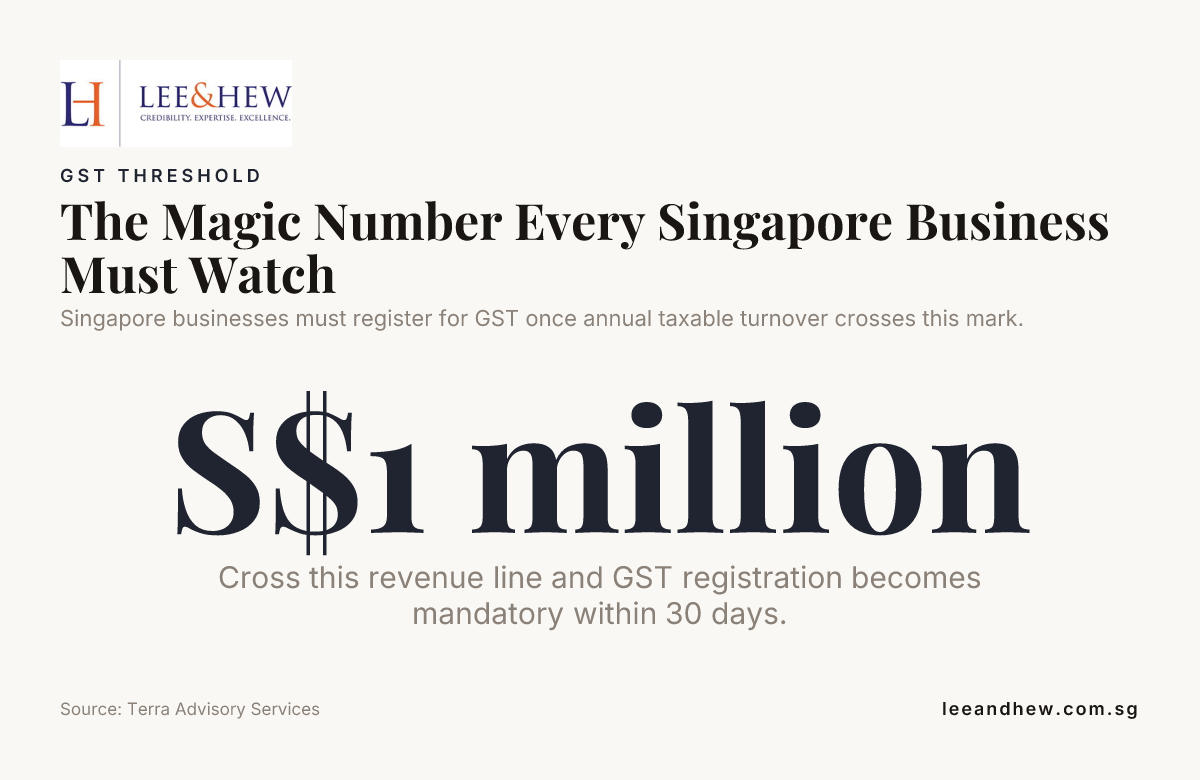 Singapore businesses must register for GST once annual taxable turnover crosses this mark.
1) Start with the GST basics that drive everything else
GST Compliance and Filing Essentials for Singapore begin with understanding how GST affects your pricing, invoices, input claims, and reporting cadence. If your team treats GST as an “end of quarter” task, you often end up classifying supplies late, reconciling invoices under time pressure and revising figures after submission.
We typically recommend you map your GST workflow in the same way you would map your financial close. For each transaction type, decide how it should be recorded, what tax code should apply, what evidence is required, and who owns the review step. This is also where Audit Services Singapore expectations become practical, because your GST position should be clear and supportable for review and assurance activities.
- Output tax: when you charge GST to customers and how you substantiate it.
- Input tax: what you can claim, and what documentation you need to claim it.
- Taxable, zero-rated, and exempt treatment: the difference matters for reporting accuracy.
- Adjustments: credit notes, refunds, and post-sale changes.
2) Register on time, and manage liability with control
GST registration becomes compulsory when taxable turnover crosses the threshold at the end of a calendar year. If you miss the trigger, or if you register based on assumptions rather than tracked sales and invoicing patterns, you can face avoidable compliance complications.
We also see businesses that register voluntarily without a clear operating plan. In those cases, the process becomes a governance exercise, because voluntary registration can mean you remain registered for at least a minimum period before cancellation is feasible. The key is to ensure your systems can sustain GST reporting properly, not just to “hit” registration.

3) Build your GST compliance process around accurate reporting categories
Most GST filing errors come from classification, not from arithmetic. If your team cannot clearly explain what you sold, what tax treatment applies, and what evidence supports it, your GST Compliance and Filing Essentials for Singapore become fragile during internal review or external enquiries.
This is where we bring a client-centric approach to compliance obligations, because each business has different supply patterns. In practice, we help you structure your GST codes, ensure correct treatment for invoices and credit notes, and prepare a reliable reconciliation between accounting records and GST returns.
If you are also planning for assurance or governance reviews, it becomes even more important to keep the GST treatment aligned with how your financial reporting is prepared. Our integrated suite of services, spanning accounting, audit, tax, and company secretarial support, is designed to ensure that every element of your financial governance is aligned. You can see how we support broader compliance needs through our services.
- Set clear rules for how invoices are captured: who enters them, when they are reviewed, and what fields are mandatory.
- Reconcile on a cycle, not after the filing due date: match supplier invoices, sales invoices, and credit notes to GST return totals.
- Document the “why” behind tax treatment: retain evidence so your position is defensible.
- Check for recurring high-risk categories: mixed supplies, inter-company transactions, and cross-border considerations.
When auditors function as trusted advisors, they move beyond simple compliance checks. That mindset benefits your GST reporting quality too, because it encourages clarity, completeness and stakeholder trust.
4) Input tax claims, documentation and record keeping that actually hold up
Input tax claims are one of the most sensitive areas of GST Compliance and Filing Essentials for Singapore. You can have strong accounting records, yet still face problems if your invoices, supporting documents and claim basis are incomplete or inconsistent.
We encourage you to treat GST documentation like audit evidence. Your systems should retain supplier documents in a way that is easy to retrieve, tag, and review. Companies are legally required to keep tax invoices, receipts, and accounting records for a period of time, because those records support input tax claims and help you substantiate decisions when questioned.
- Verify invoice requirements: ensure invoice fields align with claim requirements.
- Maintain credit note trails: update GST impact when sales are reversed or adjusted.
- Control who can change tax codes: prevent accidental reclassification after review.
- Keep a clear paper trail: working files that explain your GST position.
If you are strengthening your wider financial governance, our accounting services Singapore support outsourced finance operations and audit liaison & closing activities that pair naturally with GST preparation.
5) Filing timelines, payment discipline and avoiding late penalties
Even when your GST figures are correct, weak process discipline can lead to late filing or late payment. That is why we focus on filing cadence and internal controls, so GST Compliance and Filing Essentials for Singapore stay on-time, on-target and within budget.
A practical approach is to set up a recurring monthly or quarterly GST routine that mirrors your internal reporting cycle. You want your team to complete reconciliation early, resolve discrepancies quickly, and prepare submission files with consistent formatting and review sign-off.
- Run a “last-mile” checklist: ensure return totals match reconciliations and supporting schedules.
- Pre-empt data gaps: chase missing invoices, credit notes, and supplier documentation before close.
- Lock figures after review: reduce the risk of last-minute edits that break audit trails.
- Plan payments: align payment schedules so cash flow surprises do not become compliance issues.
Being on-time and within budget for an audit engagement does not happen by accident, it is the result of structured preparation that begins well before the audit start date.

6) When GST meets other tax obligations, treat it as a single compliance picture
GST does not exist in isolation. Your GST position interacts with other tax obligations, documentation standards and business structures, especially for companies with complex transactions or cross-border activity. For this reason, we approach tax as a holistic view, where your GST reporting is supported by your overall compliance framework.
On the tax side, our Tax Professionals can help you ensure your Singapore obligations are met with an approach that is focused in the details. This is reflected in how we cover Goods & Services Tax / VAT alongside corporate income tax, tax planning, transfer pricing, and withholding tax. If your business needs more than GST alone, we can coordinate across the full compliance obligations set.
- Transfer pricing alignment: helps you avoid inconsistencies in inter-company transactions that can spill into tax positions.
- Withholding tax considerations: can affect how cross-border payments are recorded and documented.
- Tax planning governance: supports decision-making with compliance in mind.
In short, Lee & Hew looks after all aspects of your regulatory compliance, including GST Compliance and Filing Essentials for Singapore, through a structured, methodical client-centric approach.
7) Use audit-ready working papers to make review faster
Many teams treat GST returns as a separate deliverable from financial reporting. That works until you face a review cycle, assurance work, or a question that requires reconciliation across systems. When your GST files are audit-ready, you reduce turnaround time and minimize internal rework.
In practice, this means producing clear schedules that link your sales ledger, purchase ledger, and adjustments to your GST return. It also means documenting material judgement calls, keeping a consistent revision history, and ensuring your records are traceable.
This is also where Audit Services Singapore becomes directly relevant, because strong working papers strengthen stakeholder confidence. Auditors who function as trusted advisors move beyond simple compliance checks, and that value can carry into GST governance too.

8) Practical best practices we recommend for businesses and finance teams
To keep GST Compliance and Filing Essentials for Singapore manageable, you need repeatable controls and clear ownership. We often see success when businesses build small routines that prevent errors before they appear, instead of fixing them after the filing deadline.
Here are the best practices that work across different industries and business sizes:
- Assign ownership per process: sales tax capture, purchase invoice capture, reconciliation, review and submission.
- Standardise data entry: reduce manual changes and inconsistent invoice handling.
- Keep a GST calendar: map return due dates, internal review dates and evidence collection windows.
- Reconcile earlier than you think: complete reconciliation days or weeks before submission.
- Maintain supporting schedules: make it easy to trace figures back to underlying transactions.
- Use assurance-friendly documentation: keep working papers consistent and review-ready.
- Plan for organisational change: if your team grows, revisit GST controls, not just headcount.
If you want to see how we structure broader compliance and governance content, browse Resources & Guides and our related Singapore tax materials under Singapore tax.
Conclusion: Stay compliant with GST Compliance and Filing Essentials for Singapore
GST Compliance and Filing Essentials for Singapore come down to one thing, accuracy supported by evidence, delivered on time through a disciplined process. When you classify supplies correctly, keep documentation strong, reconcile early, and prepare audit-ready working papers, GST filing becomes a controlled routine rather than an urgent scramble.
At Lee & Hew, we act as your outsourced Compliance Officer so that you can be assured that you are compliant all the way. If you are balancing GST with other compliance obligations, or you are preparing for assurance with Audit Services Singapore, we can help you coordinate the full picture with our technical competence and client-centric approach.
Frequently Asked Questions
When do I need to register for GST in Singapore?
In Singapore, GST registration is compulsory once annual taxable turnover crosses the relevant threshold at the end of a calendar year. GST Compliance and Filing Essentials for Singapore begin here, because registration triggers should be tracked using actual invoicing and sales data, not estimates.
What are the most common GST filing mistakes businesses make?
The most common issues are misclassification of supplies, incomplete documentation for input tax claims, and weak reconciliation between your accounting records and GST return figures. These errors can directly impact GST Compliance and Filing Essentials for Singapore and increase the risk of penalties during reviews.
How long do I need to keep GST records and tax invoices?
Businesses should keep tax invoices, receipts, and accounting records for a defined period to support input tax claims and compliance. Strong recordkeeping is central to GST Compliance and Filing Essentials for Singapore because it helps you substantiate your filings quickly.
Is it better to handle GST filing in-house or outsource it?
Many businesses start in-house, but outsourcing becomes practical when your transactions grow in volume or complexity, or when you need a controlled compliance process with evidence-ready working papers. We help ensure your GST Compliance and Filing Essentials for Singapore are handled with structure, review discipline and stakeholder confidence.
Can GST filing affect audit work and Audit Services Singapore engagements?
Yes. When your GST returns are supported by clear schedules and consistent evidence trails, audit review becomes faster and more reliable. This is why GST Compliance and Filing Essentials for Singapore should align with your accounting close and governance standards.
What documents do I need to support input tax claims in Singapore?
You typically need valid supplier invoices and supporting evidence that meets the requirements for claiming input tax. Keeping your documents organised and traceable is part of GST Compliance and Filing Essentials for Singapore, because claims should be defensible, not just calculated.
How do I reduce the risk of late GST payments and late filing?
We recommend building a GST calendar, reconciling earlier than the filing due date, and running a review checklist before submission. With these controls, GST Compliance and Filing Essentials for Singapore become predictable, helping you avoid penalties tied to timing.
Contact us now to find out more!